Thursday, August 24, 2006

The Prodigal Son


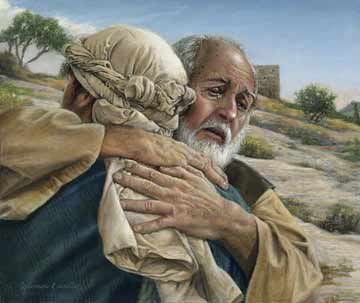
Beautiful picture isn't it? The Prodigal Son being welcomed home by the loving Father he left behind. I've always loved this picture, for it shows plainly the love and compassion upon the Father's face as he clings tightly to his long lost son, who has returned home.

This post today is more a personal plea to anyone who may have a divine appointment to come upon this, and has wandered away from the fold: Because I know what its like personally. You see, I left the safety of my Father's house one time too--staying away for years, and like the son in this picture and the one Jesus tells us about in Lukes Gospel (chapter 15) found myself in the worlds pig pen before 'coming to myself' and returning to my Fathers house.

And you know what? My Father welcomed me home just like the Father in this picture is welcoming his son...with open arms of love, forgiveness, and compassion. He'll do the same for you. I can guarentee it!

Read it for yourself-

And he said, A certain man had two sons:

And the younger of them said to his father, Father, give me the portion of goods that falleth to me. And he divided unto them his living. And not many days after the younger son gathered all together, and took his journey into a far country, and there wasted his substance with riotous living. And when he had spent all, there arose a mighty famine in that land; and he began to be in want. And he went and joined himself to a citizen of that country; and he sent him into his fields to feed swine. And he would fain have filled his belly with the husks that the swine did eat: and no man gave unto him. And when he came to himself, he said, How many hired servants of my father's have bread enough and to spare, and I perish with hunger!

I will arise and go to my father, and will say unto him, Father, I have sinned against heaven, and before thee, And am no more worthy to be called thy son: make me as one of thy hired servants.

And he arose, and came to his father. But when he was yet a great way off, his father saw him, and had compassion, and ran, and fell on his neck, and kissed him. And the son said unto him, Father, I have sinned against heaven, and in thy sight, and am no more worthy to be called thy son. But the father said to his servants, Bring forth the best robe, and put it on him; and put a ring on his hand, and shoes on his feet: And bring hither the fatted calf, and kill it; and let us eat, and be merry: For this my son was dead, and is alive again; he was lost, and is found. And they began to be merry.

It still causes me to weep when reading this story, for its a reminder of just how great God's love, mercy, and forgiveness is, and how eagerly He wants to bestow it upon us.
All it took was the son beginning the journey back home. For even as he was 'afar off'...the Father ran to meet him. Isn't that a wonderful word picture of true love and forgiveness?

I have only two more things to say.

If you're a prodigal, come home. The Father awaits you, watching daily for your first steps in His direction. Take the first step my friend, and He will run to meet you.

Also, if you know a prodigal, don't condemn them my friend, but just remind them that the Father is looking for them to return with open arms.

As one who stayed away out of a fear that I wouldn't be welcomed back, I can tell you, those away from the fold need to hear and be reminded of God's love and forgveness--for in most cases they don't 'see or hear it' from within the Church. That is sad, but true.

If not one ourselves, we know someone who can fit the picture of the wandering son: perhaps even our own son or daughter. Don't give up on them, continue to pray and lift them up before God. Stand in the gap for them.

My prayer is today , may the Holy Spirit bring all 'prodigals home' soon.

Matthew

Tuesday, August 22, 2006

Who is Jesus?

Many people have different understanding of who is Jesus. Most will agree Jesus lived in the biblical land of Palestine about 2000 years ago. The best way to find out who is Jesus is to read about him from the Bible. I like to share four important truths about Him.

He is the Son of God

Some people may misunderstand this, if Jesus is the Son of God, surely He must be less powerful than God? and God must have existed before him? This is not true, the bible says Jesus co-exist with God right from the beginning.

In the beginning was the Word, and the Word was with God, and the Word was God. John 1:1

God consists of three Persons, the Father, the Son, and the Holy Spirit. All Three are equal, yet there is only one God.

For there are three that bear record in heaven, the Father, the Word, and the Holy Ghost: and these three are one. 1 John 5:7

Jesus, being the Son, submit himself to God, He fulfills His role as a Son. To understand the concept of God consisting three Persons, consider the three-dimension space, it consist of length, width and height, all three have to co-exist together, you cannot remove any of them, and each have their role to fulfill. This is just an example to help us understand the Trinity, our finite mind will never fully comprehend it.

Jesus, being the Son of God, is therefore fully God and all powerful. No problem is too great for Him.

He is the Son of Man

Jesus is one of us! He became a human about 2000 years ago, born into this world through Mary. Mary was a virgin when she conceived Jesus, the conception is a supernatural event.

Therefore the Lord himself shall give you a sign; Behold, a virgin shall conceive, and bear a son, and shall call his name Immanuel. Isaiah 7:14

Jesus is flesh and blood like us, he understands what we go through. The bible records that He wept, he was hungry and thirsty, he faced temptation, he was rejected by people, suffered loneliness, was betrayed and persecuted, and eventually he died on the cross. There is only one difference, unlike us He lived a sinless life.

And without controversy great is the mystery of godliness: God was manifest in the flesh…”
1 Timothy 3:16


God was manifested in the flesh when Jesus became a human, like one of us. Since Jesus is fully man, He can empathies with you.

He is our Good Shepherd

The thief cometh not, but for to steal, and to kill, and to destroy: I am come that they might have life, and that they might have it more abundantly. I am the good shepherd: the good shepherd giveth his life for the sheep.
John 10:10-11


He is called the Good Shepherd.The bible says those who belong to Him are the sheep. Why does the bible compare us to a sheep? a sheep is often lost, if you think of all the problems in this world, you have to agree that mankind is lost, you just have to read the daily newspaper.
He is the Good Shepherd because He can turn us away from danger and harm, and He will lead us to green pasture, to restore and refresh our soul.

He maketh me to lie down in green pastures: he leadeth me beside the still waters. He restoreth my soul: he leadeth me in the paths of righteousness for his name's sake.
Psalms 23:2-3


He is Good Shepherd because He cares for the sheep, to the extent that He gave His life for the sheep. You need a Shepherd for your life.

He is the Christ

And Simon Peter answered and said, Thou art the Christ, the Son of the living God. And Jesus answered and said unto him, Blessed art thou, Simon Barjona: for flesh and blood hath not revealed it unto thee, but my Father which is in heaven. Matt 16:16-17

The Christ, is also known as the Messiah, the Anointed One. The bible says that Jesus is the only Christ, anyone else who claimed to be the Christ is an antichrist. Jesus is the Christ or Messiah because he came to save us from sin and death. His mission is to save the lost.

For the Son of man is come to seek and to save that which was lost. Luke 19:10

Though he lived a sinless life, he was crucified on the cross. God had intended that He became the Sacrificial Lamb for all our sins. The blood he shed on the cross is for the remission of our sins. Forgiveness is now possible because of His death on the cross. And eternal life is now possible because of His resurrection from death. What must we do to receive this gift of forgiveness and eternal life?

First, we must acknowledge our sins before Jesus, our attitude should be one of brokenness
and contrition. Next we need to tell Jesus we want to give up our sins, no more following the attraction of the world, namely the lust of the eyes, lust of the flesh and the pride of life.

Ask Jesus to come into your heart, by acknowledging Him as your Savior and Lord of your life. If you cling tight to Jesus, He will not reject you, He wants to heal you and give you a meaningful life, a life that is in accordance to God’s will, a life that abides in the presence of Jesus, a life that is pure and not contaminated by the world. We all have only one life to live on this earth, make the right decision, acknowledge your sin and unworthiness and cry out to Jesus.

Ask, and it shall be given you; seek, and ye shall find; knock, and it shall be opened unto you: For every one that asketh receiveth; and he that seeketh findeth; and to him that knocketh it shall be opened. Matthew 7:7-8

Monday, August 21, 2006

The Lord Is Coming Soon...Hold Fast!


It is not great strength or great wealth that Christ calls for in His Church on the eve of His coming. It is great faithfulness to Him and great obedience to His will and to the opportunities He gives us.

In writing to the church in Philadelphia (Rev. 3:7-13), Christ had nothing except commendation and the announcement of preservation from the period of calamity and trial which is coming to the whole earth. Let us look at why this church merited Christ�s commendation and reward.

Philadelphia was a church like the other churches of the time, existing in the midst of the corruption of paganism, and surrounded by forces which perpetually threatened to overwhelm these assemblies gathered around the risen One. To it, however, the Lord comes, announcing Himself in all the kingly majesty of actual administration:

"These things saith He that is holy, He that is true, He that hath the key of David, He that openeth, and no man shutteth; and shutteth, and no man openeth; I know thy works: behold, I have set before thee an open door, and no man can shut it: for thou hast a little strength, and hast kept My word, and hast not denied My name" (Rev. 3:7-8).

It is as though the Lord had said, "I set before you a door opened, which none could shut, and I know your works; you had a little power, and didst keep My word, and didst not deny My name." He opened the door in front of them, and they passed through it and filled the opportunity. He opened the door, and they, though having but little power, were yet true to His word, and loyal to His name. It is evident then that the commendation must be considered wholly in the light of the statement concerning the open door.

What this open door was locally, it is impossible to state. We cannot go back and examine in detail the opportunity which the Lord gave the church. In all probability, however, it was some special opening for missionary enterprise. There is almost certainly a connection between the announcement of the kingly character of Christ and His opening of the door. It is "He that hath the key of David," which is the insignia of kingship, who has opened the door, and the suggestion is that of a passport given to His dominions for the transaction of His business.

The key opens the territory of the king.

He who held the key had set before the church a door opened. He had given them entrance to some other of His dominions for the transaction of His business. The opening of the door is the king�s governmental preparation of the pathway along which His messengers are to run to do His biddings, to herald His Gospel, to win His dominion for Himself. The opening of the door is the exercise of His executive right.

Turn for a moment from the immediate and local application of these words. Let us think of them as the statement of a great principle. How wondrously in every successive century has the King opened the doors before His Church.

In spite of human opposition, and human hatred, He has unlocked and flung wide open the doors of opportunity before His faithful people.

What the particular opening for the church at Philadelphia was, we have no means of knowing. The fact of value revealed is that there came to a church which was neither great nor strong, an opportunity which the church recognized and filled.

But who are these that enter through the open door?

Mark well His description. Jesus did not say to this church at Philadelphia, "Thou art strong," but, "Thou hast a little power."

But they were faithful to the opportunity in that they kept His word and did not deny His name. That is the true principle of success in Christian service.

The greatest rewards that will ever come to churches or to men will be bestowed, not according to the greatness of the strength they had, or the greatness of the opportunity as it appeared to men � but according to fidelity to opportunity, and full use of the measure of strength possessed.

The measure of strength was small, but entering the open door the church made use of all in loyalty to His word, and in maintaining the honor of His name. In this twofold statement there is a revelation of the secret of success in all service � the keeping of the word and loyalty to the name.

It is infinitely better to have a little power, and use it within the doors He opens in loyalty to His teaching and Himself � than to have much power and use it as aiding the work of those who, robbing Him of His dignity, hinder His coming into His kingdom.

To the church at Philadelphia He says, "Because thou didst keep the word of My patience, I also will keep thee from the hour of trial, that hour which is to come upon the whole world, to try them that dwell upon the earth" (3:10).


"I Come Quickly"

In these words the Lord does for the church at Philadelphia what He has done for the Church again and again. He directs their attention to His second coming as the goal and crisis of victory. Through all the years of service the Church should ever wait for Him, hearing constantly the sound of His voice � "I come quickly!" (3:11).


"Hold Fast"

In view of that promise, consider the Master�s declaration of the present responsibility of the Church. "Hold fast that which thou hast, that no one take thy crown" (3:11). To the church at Sardis He said the same thing (3:3), and yet how different the value and application of the announcement. To Sardis it was a warning. To these at Philadelphia, it is a promise.

To the church that was dead (Sardis), it was a proclamation, calculated to startle them into obedience. To the church exercising its little strength in fulfillment of His gracious will, it was a declaration calculated to comfort them in obedience.

It is evident that the doctrine of the advent of Jesus affects persons according to the condition of their life. One church is threatened; another is comforted by the announcement of His coming.

In a little while that lies between the present moment and His coming, He marks their responsibility in the words, "Hold fast that which thou hast." What had they? A little power, His word, His name, His promise of return. These they were to hold fast, and the reason � "that no one take thy crown."

The crown referred to was that of reward for service. He had opened the door. They in little power had entered in and had fulfilled His will. He knew their works, that they had kept His word and did not deny His name. He had no complaint to make of them. He Himself was coming, and at His coming they would have their crowning. Not the crowning but the conflict is for today, but so surely as the conflict is maintained, and the things now possessed held fast, the crowning must come!


To Him Who Overcomes

Then lastly notice His promise to the overcomer. "He that overcometh, I will make him a pillar in the temple of My God, and he shall go out thence no more: and I will write upon him the name of My God, and the name of the city of My God, the new Jerusalem, which cometh down out of heaven from My God, and Mine own new name" (3:12).

The overcoming referred to in this case is not that of some evil in the church, but of the forces which are outside, and these will be finally overcome at His advent. As He has been speaking of that coming as the crisis at which all the rewards He promises will be bestowed upon the church, His promise to the overcomer is here that of those conditions of life to which they shall pass beyond that advent.

First He promises them position: "I will make him a pillar in the temple of My God." That is finality. The Bible does not speak of men as being pillars in His temple while on earth. Yonder they will have a position conspicuous and abiding, based upon the fact of their resemblance to the character of God.

Then secondly: "I will write upon him the name of My God," this indicating the fact of likeness, and the reason of the position of prominence.

And yet again, a definite and specific reward: "I will write upon him�the name of the city of My God, the new Jerusalem, which cometh down out of heaven from My God."

Those who have the right within that city, of permanent dwelling upon the basis of character, are not to be there as foreigners or aliens, but as those who have the city�s freedom, that freedom being the recognition of their overcoming.

And yet once more: "I will write upon him�Mine own new name."

What strange and mystical statement is this?

In the nineteenth chapter of this book of Revelation there is another reference to it. "He hath a name written, which no one knoweth but He Himself" (v. 12). There are yet honors for Jesus unrevealed, and these are signified in that new name.

This then is the name that He will write upon the overcomer. He will share with him all His honors and rewards. There is to be the most perfect oneness between the overcomer and the King. To suffer with Him will be to reign with Him over all the territory. To enter the door He opens today is to walk with Him in all the spacious realms over which He yet must reign.


Christ Reigns Even Now

Our crowning may depend on our fidelity, but God�s ultimate victory depends upon the King whom He has set on His holy hill. Let there be no moment in which we imagine that He has either lost ground, or abandoned any part of the territory committed to Him. He cannot fail nor be discouraged till He has accomplished the uttermost purpose of His God, and though at times our eyes may fail to trace the method of His administration, let our hearts be ever comforted by remembering "He� openeth, and none shall shut, and He shutteth and none openeth."

If we are not able to see how He opens or how He shuts, it matters little. The fact is full of infinite and inexpressible comfort. God�s anointed King, though for a time hidden from the eyes of men, is carrying on His government. As of old, David the anointed king of Israel was for a time exiled from his kingdom, and took refuge in the cave of Adullam, so for today Christ is earth�s rejected King, but He is still God�s anointed King.

The story of Adullam is full of significance. David, refused by his people, went up to the stronghold in the mountains, and there three classes of people gathered round him � men in debt, men in distress, and men that were discontented (1 Sam. 22:1-2). They were not of much account in the eyes of the nation. In all probability it was looked upon as a happy exodus when they left for the cave.

And yet how wonderful the story of their relation to David, and its results. Contact with him turned them into mighty men. The story of David and his mighty men is indeed a romance. The raw material was surely as poor as ever gathered to a man, but the finished product there has seldom been anything finer.

In process of time the glad day dawned when David left Adullam, and came to his crowning. Concerning that crowning a statement full of significance is made: "All these men�came with a perfect heart to Hebron, to make David king" (1 Chron. 12:38).

"Our Lord is now rejected,
And by the world disowned,
By the many still neglected,
And by the few enthroned."


But He is gathering to Himself a company of people in debt, in distress, and discontented, and those who have thus gathered to Him in the days of His rejection are by that contact and comradeship being transformed into His mighty men. Soon the morning will break when we shall gather with one heart to make Jesus King!

Oh, take heart!

Let there be fewer dirges sung in the sanctuary, and more paeans of praise. Let us be done with the lamentations of hope deferred � and putting on our garments of beauty, rise from the dust, and believe in our King. He at this moment holds the reins, and swaying the scepter, administers the affairs of the Kingdom of God!

Such is the comfort to be gathered from this epistle.

Then there follows a solemn word, marking our responsibility: "Hold fast that which thou hast."

Opposition is not over; Satan still has a synagogue. Open doors � and never had the Church such open doors as she has at this moment � open doors do not make strenuous fidelity unnecessary, but more than ever necessary. The Master is unlocking the doors all around, but the Church is not entering them as she should. Blindness to the fact is most utter folly.

The Church should stand ready before every door, so that the moment it is open, she may occupy the territory for Christ. When will those who conduct the commerce of heaven, manifest the same wisdom as that of the merchant princes of the earth?

If the Church is thus to be ready and responsive to the call of the King she must hold fast His word, and not deny His name.

Alas, that we have too often allowed things essential to be neglected, while we have been dealing with things of minor or of no importance.

Back to the Word of God!

Back to the Name of Jesus!

Then will the Church be what God intends she should be �

"fair as the moon, clear as the sun, terrible as an army with banners" (Song 6:10).

The test of the Church�s loyalty to Christ is not the measure of her manifestation before men, but her fidelity to the opportunity her Lord creates.

Infinitely better to have a little power only � all used for Christ � than much strength bestowed in other ways.

If He has opened the door, then let us go through in all the strength we possess, remembering that our all, with the all of all the rest � shall make His all, that is, "the nations for His inheritance, and the uttermost parts of the earth for His possession" (Psa. 2:8)


Condensed from A First-Century Message To Twentieth-Century Christians by G. Campbell Morgan. Baker Book House, Grand Rapids, Michigan. G. Campbell Morgan (1863-1945) authored many books and commentaries and ministered in Britain, Canada and U.S.A. as a pastor and itinerant evangelist.

Sunday, August 20, 2006

A Sunday Morning Word & Hello

Just wanted to say how thankful I am today for God's Grace in my life.

The world, and the majority of the folks in it seem to be going through a great time of confusion and tribulation....how thankful those of us can be, who know regardless of what is happening or what is behind the gathering storm clouds on the horizen, that we know for a surety we are safe in God's hand's. And come what may, His Grace and Mercy will carry us through unil the end.

In 26 years of knowing Him He's not let me down yet, and I'm counting on the promise that He never will.

May the Lord's love, grace and mercy, keep you today and through-out the coming week.

Matthew 5:8


Grace


Click to hear "Amazing Grace" being played in four parts on the Great Highland Bagpipe- http://www.bakedbean.co.nz/EPAMG.htm


Amazing grace, how sweet the sound
That saved a wretch like me
I once was lost, but now I'm found
Was blind, but now I see.

'Twas grace that taught my heart to fear
And grace that fear relieved
How precious did that grace appear
The hour I first believed.

Through many dangers, toils, and snares
I have already come
'Tis grace has brought me safe thus far
And grace will lead me home.

How sweet the name of Jesus sounds
In a believer's ear
It soothes his sorrows, heals his wounds
And drives away his fear.

Must Jesus bear the cross alone
And all the world go free
No, there's a cross for everyone
And there's a cross for me.

When we've been here ten thousand years
Bright shining as the sun
We've no less days to sing God's praise
Than when we first begun


'TIS A CHARMING SOUND

By Paul Hume


"Blessed is the people that know the joyful sound: they shall walk, O LORD, in the light of thy countenance" declared the inspired Psalmist of Israel. Psalm 89:15

This "joyful sound" related to the blowing of the silver trumpet for various holy day assemblies (Num. 10:10). However, there, is a sweet spiritual application for us here. Could not "the joyful sound" be what Phillip Doddridge and Augustus Toplady wrote of in their hymn "Grace! 'Tis A Charming Sound?"

"Grace! 'Tis a charming sound,
Harmonious to the ear;
Heav'n with the echo shall resound,
And all the earth shall hear.
'Twas grace that wrote my name
In life's eternal book;
'Twas grace that gave me to the Lamb,
Who all my sorrows took."


What a gem of truth lies in Acts 18:27, often never observed.

".. .who, when he, (that is, Apollos) was come, helped them much which had believed through grace" Dr. Bullinger states concerning the little preposition "through" (dia in the Greek) that "it includes the idea of proceeding from and passing out."

This would mean, then, that the grace which came out from God in Christ and had passed out to their hearing the Word of God, had caused them to believe on the Lord Jesus Christ.

Therefore, we, like they, "believe through grace."

Blessed grace of God!

You probably have run in to someone who confessed "I just can't believe the Bible"

That person is partially right.

Of himself, he cannot generate the right kind of faith by which alone God saves people. It is all of the grace, the unmerited favor of God. And everyone who is honest at heart CAN become a recipient of this enabling grace to "believe on the Lord Jesus Christ, and thou shalt be saved, and thy house."

Saturday, August 19, 2006

Ye Must Be Born Again


YE MUST BE BORN AGAIN

Words: William T. Sleeper, 1877

*cyberhymnal

A ruler once came to Jesus by night
To ask Him the way of salvation and light;
The Master made answer in words true and plain,
“Ye must be born again.”

Refrain

“Ye must be born again,
Ye must be born again,
I verily, verily, say unto thee,
Ye must be born again.”

Ye children of men, attend to the Word,
So solemnly uttered by Jesus the Lord;
And let not this message to you be in vain,
“Ye must be born again.”

Refrain

O ye who would enter that glorious rest,
And sing with the ransomed the song of the blest,
The life everlasting if ye would obtain,
“Ye must be born again.”

Refrain

A dear one in Heaven thy heart yearns to see,
At the beautiful gate may be watching for thee,
Then list to the note of this solemn refrain,
“Ye must be born again.”


There was a man of the Pharisees, named Nicodemus, a ruler of the Jews: The same came to Jesus by night, and said unto him, Rabbi, we know that thou art a teacher come from God: for no man can do these miracles that thou doest, except God be with him.

Jesus answered and said unto him, Verily, verily, I say unto thee, Except a man be born again, he cannot see the kingdom of God.

Nicodemus saith unto him, How can a man be born when he is old? can he enter the second time into his mother's womb, and be born?

Jesus answered, Verily, verily, I say unto thee, Except a man be born of water and of the Spirit, he cannot enter into the kingdom of God. That which is born of the flesh is flesh; and that which is born of the Spirit is spirit. Marvel not that I said unto thee, Ye must be born again. The wind bloweth where it listeth, and thou hearest the sound thereof, but canst not tell whence it cometh, and whither it goeth: so is every one that is born of the Spirit. John 3:1-8

THE TWO BIRTHS:

A true child of God has two births; one of the flesh, the other of the Spirit, giving man a flesh nature and a Spirit nature. The flesh nature is neither good nor righteous. This results in warfare between the Spirit andthe flesh, which continues until physical death, or the return of the Lord.

The flesh nature of the man does not change in any way with the new birth, but can be controlled and kept under submission by the new man through prayerful submission to God. John 3:3-7; Romans 7:15-25; Romans 8:8; Gal. 5:17; I John 3:9; I Peter 1:23; IJohn 5:18, I John 1:8

It is by the calling of the Holy Spirit, and our response to this call, that we are born again into the Kingdom of God. It is He [the Holy Spirit] alone who calls us, who convicts of sin which leads to true sorrowful repentance, and who 'keeps us unto that day'.

Man is saved by undeserved mercy through faith and nothing of man enters into his salvation; it is a free gift.

Man's efforts, regardless of how good or well intended, before or after salvation, have nothing to do with it.

Salvation is by the finished work of Christ and nothing can be added to it.

Anything added to the 'Good News' message of salvation by grace through faith alone, is an accursed message and becomes 'another Gospel'


AN ACCURSED MESSAGE

1. An accursed message is a perversion of the gospel of Christ.
Galatians 1:7.

2. An accursed message is a perversion of the gospel of Christ, and therefore the teller of this message is telling a lie. Proverbs 30:4-6.

3. An accursed message is a perversion of the gospel of Christ and is a subtle way of calling God a liar. l John 5:10.

4. An accursed message is a perversion of the gospel of Christ by adding man's righteousness as a condition of salvation. Isaiah 64:6.

5. An accursed message is a perversion of the gospel of Christ and is in reality the preaching of a false Gospel which will not save anyone. ICorinthians 1:17.

6. An accursed message is a perversion of the gospel of Christ and is a message that causes the lost to be blinded to the truth. II Corinthians 4:4.

7. An accursed message is a perversion of the gospel of Christ and causes saved persons to become confused. Galatians 2:13; I Corinthians 1:10; I Corinthians 15:11.

8. An accursed message is a perversion of the gospel of Christ and keeps the true Christian from a clear witness. Galatians 2:16.

9. An accursed message is a perversion of the gospel of Christ and brings persecution to the preacher of the true message. Galatians 5:11.

10. An accursed message is a perversion of the gospel of Christ and is in reality the preaching of a religion that will not save anyone. lCorinthians 1:17.

Most Christians are not aware of how serious it is to add to what Jesus Christ said was finished.

-It is the difference between whether or not a person is truly saved.

-It is the difference between heaven and hell.

"For by grace are you saved through faith; and that not of yourselves; it is the gift of God: Not of works, lest any man should boast. Ephesians 2:8,9

Acts 15:11 says, "But we believe that through the Grace of the Lord Jesus Christ we shall be saved."

Eternal life is not received by, attained by, or kept by a person's works.

We are saved by grace through faith alone.

Grace by definition excludes all works.

"And if by grace, then it is no more of works: otherwise grace is no more grace. But if it be of works, then it is no more grace; otherwise work is no more work. Romans 11:6

One work added to grace would render it no more grace. If you were to add one drop of poison to a glass of pure water, it would render it no more a glass of pure water: but a glass of poisoned water. The gospel of the grace becomes poisoned when just one human work is added to the plan ofsalvation.

THE GRACE TEST

What is the grace test? This is an easy way of testing whether or not you have the true message of the gospel as it is given in the Bible.

You simply ask, "Did Jesus pay for all my sins on the cross?" or; "Do I have to do something more then believe by faith to gain my salvation?"

If you belive you have to do anything at all to be saved, then you have not heard the true Gospel message, and have failed the grace test.

You will stand before God on the basis of your works (Your righteousness] which are as filthy rags in the sight of God. Isaiah 64:6

You don't want to do that my friend.

Remember, don't listen to anyone who tries to tell you anything less or more then the truth; which is Salvation is the gift of God. Romans 6:23

Friday, August 18, 2006

The Pure In Heart

The Pure In Heart


Matthew 5:8- Blessed are the pure in heart: for they shall see God.


As we find ourselves in the days of apostasy, the falling away spoken of by Paul in 2Thessalonians-2:3, this falling away from truth has taken on many forms.

While most bible believing Christians are made aware of the compromising doctrines and false teachings which have infiltrated the body, there is another side to this 'great falling away' which in most part, is being unnoticed.

This is a return to legalism, and salvation by works: an 'adding on' to the Gospel message.

And while false teachings, and false doctrine is indeed a very important issue, needing to be pointed out at all times, the other side of this 'apostasy coin' is just as important. For it too is a part of the great falling away from the truth of the Simplicity found in Christ alone and the Gospel message. For in its deception it seeks to add to the work of the Cross, and by doing this, denies the completeness of this work along with a denial of the keeping power of the Holy Spirit, and limits the work of the blood of Christ.

In many ways it is understandable that Christians, out of a sense of fear concerning the watered down Gospel message, and the perverting of the teachings of Christ which are abounding, have fallen into this trap: but nevertheless, it is indeed a trap. 


We stand by the word's of our Lord, for truly only the pure in heart shall see God: and while it be true, that all men's righteousness is as filthy rags we have the promise of salvation and eternal life by our faith in the once shed atoning blood of Jesus Christ, for the remission of sins.

Jesus + "anything else" does not equal true salvation


*Quotes from the pulpit of Jonathan Edwards on the Pure Heart

GOD formerly delivered his law from mount Sinai by an audible voice, with the sound of a trumpet, with the appearance of devouring fire, with thunders, and lightnings, and earthquakes. But the principal discoveries of God’s Word and will to mankind were reserved to be given by Jesus Christ, his own Son, and the Redeemer of men, who is the light of the world.

Here is God speaking, as well as from mount Sinai, and as immediately, but after a very different manner. There God spake by a preternatural formation of sounds in the air. Here he becomes incarnate, takes on him our nature, and speaks, and converses with us, not in a preternatural, awful, and terrible manner, but familiarly as one of us. His face was beheld freely by all that were about him. His voice was human, without those terrors which made the children of Israel desire that God might speak to them immediately no more. And the revelation which he makes of God’s Word is more clear and perfect, and fuller of the discoveries of spiritual duties, of the spiritual nature of the command of God, of our spiritual and true happiness, and of mercy and grace to mankind.

John 1:17, “For the law was given by Moses, but grace and truth came by Jesus Christ.”

This discourse of Christ on the mount seems principally leveled against the false notions, and carnal prejudices, that were at that day embraced by the nation of the Jews. And those benedictions, which we have in the beginning of his sermon, were sayings that were mere paradoxes to them, wholly contrary to the notions which they had received.

That he, who was poor in spirit, was blessed, was a doctrine contrary to the received opinion of the world, and especially of that nation, who were exceedingly ambitious of the praise of men, and highly conceited of their own righteousness.

And that he was a blessed and happy man, who mourned for sin, and lived mortified to the pleasures and vanities of the world, was contrary to their notions, who placed their highest happiness in worldly and carnal things.

So also that they who were meek were blessed, was another doctrine very contrary to their notions.

Equally strange to them was the declaration that they who hungered and thirsted after righteousness were happy. For they placed their happiness, not in possessing a high degree of righteousness, but in having a great share of worldly good. They were wont to labor for the meat that perisheth. They had no notion of any such thing as spiritual riches, or of happiness in satisfying a spiritual appetite.

The Jews were dreadfully in the dark at that day about spiritual things. The happiness which they expected by the Messiah was a temporal and carnal, and not a spiritual, happiness.

Christ also tells them that they were blessed who were merciful and who were peacemakers, which was also a doctrine that the Jewish religious leaders especially stood in need of at that day, for they were generally of a cruel, unmerciful, persecuting spirit.

The truth which Christ teaches them in the text, that they were blessed who were pure in heart, was a thing wholly beyond their conceptions.

The Jews at this time placed almost the whole of religion in external things, in a conformity to the rites and ceremonies of the law of Moses. They laid great stress on tithing mint, and anise, and cumin, and on their traditions, as in washing hands before meat and the like. But they neglected the weightier matters of the law, and especially such as respected holiness of heart.

They took much more care to have clean hands, and a clean outside, than a clean heart, as Christ tells them, Mat. 23:25, 27;

“Woe unto you, scribes and Pharisees, hypocrites! for ye make clean the outside of the cup and of the platter, but within ye are full of extortion and excess. Thou blind Pharisee, cleanse first that which is within the cup and platter, that the outside of them may be clean also.”


 What is meant by seeing God.

It is not any sight with the bodily eyes. The blessedness of the soul does not enter in at that door. This would make the blessedness of the soul dependent on the body, or the happiness of man’s superior part dependent on the inferior.

God is a spirit, and is not to be seen with the bodily eyes. We find it attributed to God that he is invisible.

Heb. 11:27, “As seeing him, who is invisible.” Col. 1:15, “Who is the image of the invisible God.”

It is mentioned as a part of God’s glory. 1 Tim. 1:17, “Now unto the King eternal, immortal, invisible, the only wise God, be honour and glory for ever and ever. Amen.”

That it is not any sight with the bodily eyes is evident because the unembodied souls of the saints see God, and the angels also, who are spirits and were never united to bodies.

Mat. 18:10, “Take heed that ye despise not one of these little ones: for I say unto you, that in heaven their angels do always behold the face of my Father which is in heaven.”

Thus it was when the three disciples beheld Christ at his transfiguration upon the mount.

They beheld a wonderful outward glory in Christ’s body, an inexpressible beauty in his countenance. But that outward glory and beauty delighted them principally as an expression of the divine excellencies of his mind, as we may see from their manner of speaking of it. It was the sweet mixture of majesty and grace in his countenance, by which they were ravished. 2 Pet. 1:16, 17, 18,

“We were eye-witnesses of his majesty. For he received from God the Father honour and glory, when there came such a voice to him from the excellent glory, This is my beloved Son, in whom I am well pleased. And this voice which came from heaven we heard, when we were with him in the holy mount.”

But especially from the account which John gives of it. John 1:14, “And the Word was made flesh, and dwelt among us (and we beheld his glory, the glory as of the only-begotten of the Father), full of grace and truth;”

But to see God is this. It is to have an immediate, sensible, and certain understanding of God’s glorious excellency and love.

There is a certain understanding of his love, there is a certain apprehension of his presence. He that beholds God, does not merely see him as present by his essence, for so he is present with all, both godly and ungodly. But he is more especially present with those whom he loves, he is graciously present with them. And when they see him, they see him and know him to be so. They have an understanding of his love to them. They see him from love manifesting himself to them. He that has a blessed-making sight of God, not only has a view of God’s glory and excellency, but he views it as having a property in it. He sees God’s love to him. He receives the testimonies and manifestations of that love.


http://www.jonathanedwards.com/sermons/Pastoral/Pure%20in%20heart.htm