There is a wide difference--in both principle and
practice--between the the godly and the ungodly.
The affections of the godly are refined--and their
desires exalted. The inclinations of the ungodly
are corrupt--and their desires groveling.
Sin has but a tottering standing, and a momentary
abode--in the godly. But sin has fixed its throne,
and taken up its eternal residence--in the ungodly.
In the godly, grace and sin struggle for sovereignty.
In the ungodly, sin domineers and there is no struggle.
The godly is deeply concerned about world to come.
The ungodly has no concern about eternal realities.
The speech of the godly is seasoned with grace.
The discourse of the ungodly is insipid and vain.
The godly has his hope fixed on God.
The ungodly has no fear of God before his eyes.
The godly use the world without abusing it.
The ungodly, in using the world, abuse both themselves and it.
The godly confesses God in his daily life, and rejoices
with his whole heart in Him. The ungodly says in his
practice--"there is no God" and wishes in his heart,
that there were no God.
The godly adores the Creator above all else.
The ungodly worships the 'creature' more than the Creator.
The godly uses God's name with profoundest reverence,
and departs from iniquity. The ungodly profanes God's
name with impudence, and adds iniquity to sin.
The godly redeems his time.
The ungodly trifles away his time.
The godly studies his duty in obedience to all God's precepts.
The ungodly shakes himself loose from every command of God.
The godly forgives his foes.
The ungodly lays a snare for his foes.
The godly commits it to God to avenge his wrong.
The ungodly, fiery and tumultuous--seeks revenge.
The godly loves chastity in all things.
The ungodly wallows in uncleanness.
The godly is content with his condition.
The ungodly covets all the day long.
The godly is pure in heart. The heart of the
ungodly is like a cage full of unclean birds.
The godly walks at liberty in the ways of God.
The ungodly is the servant and slave of sin.
The Holy Spirit rules in the heart of the godly.
Satan rules in the heart of the ungodly.
The godly has his conversation in heaven.
The ungodly has his conversation in hell.
As there is such a wide difference in their principles
and practices--so also, in their eternal destinies.
God is faithful--He has promised felicity to the pious,
and threatened vengeance to the wicked. "The wicked
is thrust out in his wickedness; but the righteous has
hope in his death." Proverbs 14:32
The godly are under the blessing of God's love.
The ungodly are under the curse of God's law.
The godly with joy, draw water out of the wells of salvation.
The ungodly shall drink of the wrath of the Almighty.
To the godly pertain all the exceeding great and precious promises.
To the ungodly pertain all the threatenings of God.
Heaven shall be the palace of the godly!
Hell shall be the prison of the ungodly!
While the godly shall dwell through eternity with God, the
ungodly shall be driven away into everlasting darkness!
Thus, the righteous and wicked are separated in their
life, and divided in their death. They are divided . . .
in their principles,
in their practices,
in their choices,
in their joys,
in their thoughts,
in their company,
in their speech,
in their fears,
in their expectations,
in their death,
and through eternity itself!
(James Meikle, "The Traveler" June 14, 1758)
Thursday, May 24, 2007


Monday, May 07, 2007
The transforming power of the Spirit!
"To all those in Rome who are loved by God
and called to be saints." Romans 1:7
Believers are separated from the world by the
effectual working of the Holy Spirit. The Spirit
calls them out from the world, and separates
them as effectually as if a wall were built
between them and it. He puts in them . . .
new hearts,
new minds,
new tastes,
new desires,
new sorrows,
new joys,
new wishes,
new pleasures,
new longings.
He gives them . . .
new eyes,
new ears,
new affections,
new opinions.
He makes them new creatures. They are born
again--and with a new birth they begin a new
existence. Mighty indeed is the transforming
power of the Spirit!
(J. C. Ryle, "The Lord's Garden")
and called to be saints." Romans 1:7
Believers are separated from the world by the
effectual working of the Holy Spirit. The Spirit
calls them out from the world, and separates
them as effectually as if a wall were built
between them and it. He puts in them . . .
new hearts,
new minds,
new tastes,
new desires,
new sorrows,
new joys,
new wishes,
new pleasures,
new longings.
He gives them . . .
new eyes,
new ears,
new affections,
new opinions.
He makes them new creatures. They are born
again--and with a new birth they begin a new
existence. Mighty indeed is the transforming
power of the Spirit!
(J. C. Ryle, "The Lord's Garden")
Wednesday, April 25, 2007
Blessed are The Poor in Spirit
"Blessed are the poor in spirit, for theirs is the kingdom of heaven." Matthew 5:3
"Blessed are the poor in spirit;" that is--the broken and humble in heart, who has no high thoughts or conceits of himself--but is lowly in his own eyes, like a young child.
"Blessed are the poor in spirit;" that is--he who has no lofty or puffed up spirit. The poor in spirit are those who are lowly, being truly conscious of their own unworthiness. None are poor in spirit--but the humble.
"Blessed are the poor in spirit;" that is--blessed are those whose spirits are brought into such a humble gracious frame, as willingly, quietly, and contentedly to lie down in a poor low condition--when it is the pleasure of the Lord to bring them into such a condition.
"Blessed are the poor in spirit;" that is--blessed are those who are truly and sincerely sensible of their spiritual needs, poverty, and misery. They see an utter inability and insufficiency in themselves, and in all other creatures to deliver them out of their sinful and miserable estate.
They see nothing in themselves upon which they dare
venture their everlasting estates, and therefore fly to the free, rich, sovereign, and glorious grace of God in Christ, as to their sure and only sanctuary!
They see their need of God's free grace to pardon them.
They see their need of Christ's righteousness to clothe them.
They see their need of the Spirit of Christ to purge, change, and sanctify them.
They see their need of more heavenly wisdom to counsel them.
They see their need of more . . .
-of the power of God--to support them,
-of the goodness of God--to supply them,
-of the mercy of God--to comfort them,
-of the presence of God--to refresh them,
-of the patience of God--to bear with them, etc.
They see their need of greater measures of faith
--to conquer their fears.
They see their need of greater measures of wisdom--
to walk holy, harmlessly, blamelessly, and exemplary
in the midst of temptations, snares, and dangers.
They see their need of greater measures of patience
--to bear their burdens without fretting or fainting.
They see their need of greater measures of zeal
and courage--to bear up bravely against all sorts
of opposition, both from within and from without.
They see their need of greater measures of love
--to cleave to the Lamb, and to follow the Lamb
wherever He goes.
They see their need of living in a continual dependence upon God and Christ--for fresh influences, incomes, and supplies of grace, of comfort, of strength--by which they may be enabled . .
-to live for God,
-to walk with God,
-to glorify God,
-to bring forth fruit to God,
-to withstand all temptations which
-tend to lead the heart away from God.
"Blessed are the poor in spirit, for theirs is the kingdom of heaven." Matthew 5:3
Thomas Brooks, "A Cabinet of Choice Jewels" 1669
"Blessed are the poor in spirit;" that is--the broken and humble in heart, who has no high thoughts or conceits of himself--but is lowly in his own eyes, like a young child.
"Blessed are the poor in spirit;" that is--he who has no lofty or puffed up spirit. The poor in spirit are those who are lowly, being truly conscious of their own unworthiness. None are poor in spirit--but the humble.
"Blessed are the poor in spirit;" that is--blessed are those whose spirits are brought into such a humble gracious frame, as willingly, quietly, and contentedly to lie down in a poor low condition--when it is the pleasure of the Lord to bring them into such a condition.
"Blessed are the poor in spirit;" that is--blessed are those who are truly and sincerely sensible of their spiritual needs, poverty, and misery. They see an utter inability and insufficiency in themselves, and in all other creatures to deliver them out of their sinful and miserable estate.
They see nothing in themselves upon which they dare
venture their everlasting estates, and therefore fly to the free, rich, sovereign, and glorious grace of God in Christ, as to their sure and only sanctuary!
They see their need of God's free grace to pardon them.
They see their need of Christ's righteousness to clothe them.
They see their need of the Spirit of Christ to purge, change, and sanctify them.
They see their need of more heavenly wisdom to counsel them.
They see their need of more . . .
-of the power of God--to support them,
-of the goodness of God--to supply them,
-of the mercy of God--to comfort them,
-of the presence of God--to refresh them,
-of the patience of God--to bear with them, etc.
They see their need of greater measures of faith
--to conquer their fears.
They see their need of greater measures of wisdom--
to walk holy, harmlessly, blamelessly, and exemplary
in the midst of temptations, snares, and dangers.
They see their need of greater measures of patience
--to bear their burdens without fretting or fainting.
They see their need of greater measures of zeal
and courage--to bear up bravely against all sorts
of opposition, both from within and from without.
They see their need of greater measures of love
--to cleave to the Lamb, and to follow the Lamb
wherever He goes.
They see their need of living in a continual dependence upon God and Christ--for fresh influences, incomes, and supplies of grace, of comfort, of strength--by which they may be enabled . .
-to live for God,
-to walk with God,
-to glorify God,
-to bring forth fruit to God,
-to withstand all temptations which
-tend to lead the heart away from God.
"Blessed are the poor in spirit, for theirs is the kingdom of heaven." Matthew 5:3
Thomas Brooks, "A Cabinet of Choice Jewels" 1669
Monday, April 16, 2007
Blessed are those who mourn
"Blessed are those who mourn, for they will be comforted."
Matthew 5:4
"Blessed are those who mourn;" that is—such as who mourn for sin with an exceeding great mourning.
"Blessed are those who mourn;" that is—those who mourn for sin with a funeral sorrow, as the word signifies.
"Blessed are those who mourn;" that is—those who mourn for sin as a man mourns for the loss of his only son, Zech. 12:10, or as Jacob mourned for Joseph, or as David mourned for Absalom, or as the people mourned for the loss of good Josiah, 2 Chron. 35:24-25.
"Blessed are those who mourn;" that is—those who mourn for secret sins as well as open sins.
"Blessed are those who mourn;" that is—those who mourn for sins against grace as well as for sins against the law.
"Blessed are those who mourn;" that is—those who mourn for sin as the greatest evil in the world.
"Blessed are those who mourn;" that is—those who mourn for his own sins, Ezek. 7:16; as David did, Psalm 51; or as Ephraim did, Jer. 31:18-19; or as Peter did, Mat. 26:75; or as Mary Magdalene did, Luke 7:38
"Blessed are those who mourn;" that is—those who mourn for the sins of others as well as for his own, as David did, Psalm 119:136, 158; or as Jeremiah did, Jer. 13:17; or as Lot did, 2 Peter 2:7-8; or as they did in that Ezek. 9:4.
"Blessed are those who mourn;" that is—those who mourn under the sense of their spiritual needs.
"Blessed are those who mourn;" that is—those who mourns under the sense of their spiritual losses—such as loss of communion with God, loss of the favor of God, loss of the presence of God, loss of the exercise of grace, loss of the joys of the Spirit, loss of inward peace, etc.
"Blessed are those who mourn;" that is—those who mourn not only for their own afflictions and miseries—but also for the afflictions and miseries of other believers, as Nehemiah did, Neb. 1:2-4; or as Jeremiah did, Jer. 9:1-2; or as Christ did when he wept over Jerusalem, Luke 19:41-42.
"Blessed are those who mourn;" that is—those who mourn because they cannot mourn for these things; or who mourn because they can mourn no more; or who mourn because God has so little honor in their hearts, or in their house, or in their life, or in the world, or in the churches.
Excerpt from Thomas Brooks, 1669
Matthew 5:4
"Blessed are those who mourn;" that is—such as who mourn for sin with an exceeding great mourning.
"Blessed are those who mourn;" that is—those who mourn for sin with a funeral sorrow, as the word signifies.
"Blessed are those who mourn;" that is—those who mourn for sin as a man mourns for the loss of his only son, Zech. 12:10, or as Jacob mourned for Joseph, or as David mourned for Absalom, or as the people mourned for the loss of good Josiah, 2 Chron. 35:24-25.
"Blessed are those who mourn;" that is—those who mourn for secret sins as well as open sins.
"Blessed are those who mourn;" that is—those who mourn for sins against grace as well as for sins against the law.
"Blessed are those who mourn;" that is—those who mourn for sin as the greatest evil in the world.
"Blessed are those who mourn;" that is—those who mourn for his own sins, Ezek. 7:16; as David did, Psalm 51; or as Ephraim did, Jer. 31:18-19; or as Peter did, Mat. 26:75; or as Mary Magdalene did, Luke 7:38
"Blessed are those who mourn;" that is—those who mourn for the sins of others as well as for his own, as David did, Psalm 119:136, 158; or as Jeremiah did, Jer. 13:17; or as Lot did, 2 Peter 2:7-8; or as they did in that Ezek. 9:4.
"Blessed are those who mourn;" that is—those who mourn under the sense of their spiritual needs.
"Blessed are those who mourn;" that is—those who mourns under the sense of their spiritual losses—such as loss of communion with God, loss of the favor of God, loss of the presence of God, loss of the exercise of grace, loss of the joys of the Spirit, loss of inward peace, etc.
"Blessed are those who mourn;" that is—those who mourn not only for their own afflictions and miseries—but also for the afflictions and miseries of other believers, as Nehemiah did, Neb. 1:2-4; or as Jeremiah did, Jer. 9:1-2; or as Christ did when he wept over Jerusalem, Luke 19:41-42.
"Blessed are those who mourn;" that is—those who mourn because they cannot mourn for these things; or who mourn because they can mourn no more; or who mourn because God has so little honor in their hearts, or in their house, or in their life, or in the world, or in the churches.
Excerpt from Thomas Brooks, 1669
Saturday, April 07, 2007
A Physician's View of the Crucifixion of Jesus Christ
By Dr. C. Truman Davis
About a decade ago, reading Jim Bishop’s The Day Christ Died, I realized that I had for years taken the Crucifixion more or less for granted — that I had grown callous to its horror by a too easy familiarity with the grim details and a too distant friendship with our Lord. It finally occurred to me that, though a physician, I didn’t even know the actual immediate cause of death. The Gospel writers don’t help us much on this point, because crucifixion and scourging were so common during their lifetime that they apparently considered a detailed description unnecessary.
So we have only the concise words of the Evangelists: “Pilate, having scourged Jesus, delivered Him to them to be crucified — and they crucified Him.” I have no competence to discuss the infinite psychic and spiritual suffering of the Incarnate God atoning for the sins of fallen man. But it seemed to me that as a physician I might pursue the physiological and anatomical aspects of our Lord’s passion in some detail.
What did the body of Jesus of Nazareth actually endure during those hours of torture?
This led me first to a study of the practice of crucifixion itself; that is, torture and execution by fixation to a cross. I am indebted to many who have studied this subject in the past, and especially to a contemporary colleague, Dr. Pierre Barbet, a French surgeon who has done exhaustive historical and experimental research and has written extensively on the subject.
Apparently, the first known practice of crucifixion was by the Persians. Alexander and his generals brought it back to the Mediterranean world — to Egypt and to Carthage. The Romans apparently learned the practice from the Carthaginians and (as with almost everything the Romans did) rapidly developed a very high degree of efficiency and skill at it. A number of Roman authors (Livy, Cicer, Tacitus) comment on crucifixion, and several innovations, modifications, and variations are described in the ancient literature. For instance, the upright portion of the cross (or stipes) could have the cross-arm (or patibulum) attached two or three feet below its top in what we commonly think of as the Latin cross. The most common form used in our Lord’s day, however, was the Tau cross, shaped like our T.
In this cross, the patibulum was placed in a notch at the top of the stipes. There is archeological evidence that it was on this type of cross that Jesus was crucified. Without any historical or biblical proof, Medieval and Renaissance painters have given us our picture of Christ carrying the entire cross. But the upright post, or stipes, was generally fixed permanently in the ground at the site of execution and the condemned man was forced to carry the patibulum, weighing about 110 pounds, from the prison to the place of execution.
Many of the painters and most of the sculptors of crucifixion, also show the nails through the palms. Historical Roman accounts and experimental work have established that the nails were driven between the small bones of the wrists (radial and ulna) and not through the palms. Nails driven through the palms will strip out between the fingers when made to support the weight of the human body. The misconception may have come about through a misunderstanding of Jesus’ words to Thomas, “Observe my hands.” Anatomists, both modern and ancient, have always considered the wrist as part of the hand.
A titulus, or small sign, stating the victim’s crime was usually placed on a staff, carried at the front of the procession from the prison, and later nailed to the cross so that it extended above the head. This sign with its staff nailed to the top of the cross would have given it somewhat the characteristic form of the Latin cross.
But, of course, the physical passion of the Christ began in Gethsemane. Of the many aspects of this initial suffering, the one of greatest physiological interest is the bloody sweat. It is interesting that St. Luke, the physician, is the only one to mention this. He says, “And being in agony, He prayed the longer. And His sweat became as drops of blood, trickling down upon the ground.” Every ruse (trick) imaginable has been used by modern scholars to explain away this description, apparently under the mistaken impression that this just doesn’t happen. A great deal of effort could have been saved had the doubters consulted the medical literature. Though very rare, the phenomenon of Hematidrosis, or bloody sweat, is well documented. Under great emotional stress of the kind our Lord suffered, tiny capillaries in the sweat glands can break, thus mixing blood with sweat. This process might well have produced marked weakness and possible shock.
After the arrest in the middle of the night, Jesus was next brought before the Sanhedrin and Caiphus, the High Priest; it is here that the first physical trauma was inflicted.
A soldier struck Jesus across the face for remaining silent when questioned by Caiphus. The palace guards then blind-folded Him and mockingly taunted Him to identify them as they each passed by, spat upon Him, and struck Him in the face.
In the early morning, battered and bruised, dehydrated, and exhausted from a sleepless night, Jesus is taken across the Praetorium of the Fortress Antonia, the seat of government of the Procurator of Judea, Pontius Pilate. You are, of course, familiar with Pilate’s action in attempting to pass responsibility to Herod Antipas, the Tetrarch of Judea. Jesus apparently suffered no physical mistreatment at the hands of Herod and was returned to Pilate.
It was then, in response to the cries of the mob, that Pilate ordered Bar-Abbas released and condemned Jesus to scourging and crucifixion. There is much disagreement among authorities about the unusual scourging as a prelude to crucifixion. Most Roman writers from this period do not associate the two. Many scholars believe that Pilate originally ordered Jesus scourged as his full punishment and that the death sentence by crucifixion came only in response to the taunt by the mob that the Procurator was not properly defending Caesar against this pretender who allegedly claimed to be the King of the Jews. Preparations for the scourging were carried out when the Prisoner was stripped of His clothing and His hands tied to a post above His head. It is doubtful the Romans would have made any attempt to follow the Jewish law in this matter, but the Jews had an ancient law prohibiting more than forty lashes. The Roman legionnaire steps forward with the flagrum (or flagellum) in his hand. This is a short whip consisting of several heavy, leather thongs with two small balls of lead attached near the ends of each. The heavy whip is brought down with full force again and again across Jesus’ shoulders, back, and legs.
At first the thongs cut through the skin only.
Then, as the blows continue, they cut deeper into the subcutaneous tissues, producing first an oozing of blood from the capillaries and veins of the skin, and finally spurting arterial bleeding from vessels in the underlying muscles. The small balls of lead first produce large, deep bruises which are broken open by subsequent blows. Finally the skin of the back is hanging in long ribbons and the entire area is an unrecognizable mass of torn, bleeding tissue. When it is determined by the centurion in charge that the prisoner is near death, the beating is finally stopped. The half-fainting Jesus is then untied and allowed to slump to the stone pavement, wet with His own blood.
The Roman soldiers see a great joke in this provincial Jew claiming to be king. They throw a robe across His shoulders and place a stick in His hand for a scepter. They still need a crown to make their travesty complete. Flexible branches covered with long thorns (commonly used in bundles for firewood) are plaited into the shape of a crown and this is pressed into His scalp. Again there is copious bleeding, the scalp being one of the most vascular areas of the body.
After mocking Him and striking Him across the face, the soldiers take the stick from His hand and strike Him across the head, driving the thorns deeper into His scalp.
Finally, they tire of their sadistic sport and the robe is torn from His back. Already having adhered to the clots of blood and serum in the wounds, its removal causes excruciating pain just as in the careless removal of a surgical bandage, and almost as though He were again being whipped the wounds once more begin to bleed. In deference to Jewish custom, the Romans return His garments. The heavy patibulum of the cross is tied across His shoulders, and the procession of the condemned Christ, two thieves, and the execution detail of Roman soldiers headed by a centurion begins its slow journey along the Via Dolorosa.
In spite of His efforts to walk erect, the weight of the heavy wooden beam, together with the shock produced by copious blood loss, is too much. He stumbles and falls. The rough wood of the beam gouges into the lacerated skin and muscles of the shoulders. He tries to rise, but human muscles have been pushed beyond their endurance. The centurion, anxious to get on with the crucifixion, selects a stalwart North African onlooker, Simon of Cyrene, to carry the cross. Jesus follows, still bleeding and sweating the cold, clammy sweat of shock, until the 650 yard journey from the fortress Antonia to Golgotha is finally completed. Jesus is offered wine mixed with myrrh, a mild analgesic mixture. He refuses to drink. Simon is ordered to place the patibulum on the ground and Jesus quickly thrown backward with His shoulders against the wood. The legionnaire feels for the depression at the front of the wrist. He drives a heavy, square, wrought-iron nail through the wrist and deep into the wood. Quickly, he moves to the other side and repeats the action, being careful not to pull the arms to tightly, but to allow some flexion and movement. The patibulum is then lifted in place at the top of the stipes and the titulus reading, “Jesus of Nazareth, King of the Jews,” is nailed in place.
The left foot is now pressed backward against the right foot, and with both feet extended, toes down, a nail is driven through the arch of each, leaving the knees moderately flexed. The Victim is now crucified. As He slowly sags down with more weight on the nails in the wrists, excruciating pain shoots along the fingers and up the arms to explode in the brain — the nails in the wrists are putting pressure on the median nerves.
As He pushes Himself upward to avoid this stretching torment, He places His full weight on the nail through His feet. Again there is the searing agony of the nail tearing through the nerves between the metatarsal bones of the feet. At this point, as the arms fatigue, great waves of cramps sweep over the muscles, knotting them in deep, relentless, throbbing pain. With these cramps comes the inability to push Himself upward. Hanging by his arms, the pectoral muscles are paralyzed and the intercostal muscles are unable to act. Air can be drawn into the lungs, but cannot be exhaled. Jesus fights to raise Himself in order to get even one short breath. Finally, carbon dioxide builds up in the lungs and in the blood stream and the cramps partially subside. Spasmodically, he is able to push Himself upward to exhale and bring in the life-giving oxygen.
It was undoubtedly during these periods that He uttered the seven short sentences recorded:
The first, looking down at the Roman soldiers throwing dice for His seamless garment, “Father, forgive them for they know not what they do.”
The second, to the penitent thief, “Today thou shalt be with me in Paradise.”
The third, looking down at the terrified, grief-stricken adolescent John — the beloved Apostle — he said, “Behold thy mother.” Then, looking to His mother Mary, “Woman behold thy son.”
The fourth cry is from the beginning of the 22nd Psalm, “My God, my God, why has thou forsaken me?”
Jesus experienced hours of limitless pain, cycles of twisting, joint-rending cramps, intermittent partial asphyxiation, searing pain where tissue is torn from His lacerated back as He moves up and down against the rough timber. Then another agony begins -- a terrible crushing pain deep in the chest as the pericardium slowly fills with serum and begins to compress the heart. One remembers again the 22nd Psalm, the 14th verse: “I am poured out like water, and all my bones are out of joint; my heart is like wax; it is melted in the midst of my bowels.”
It is now almost over.
The loss of tissue fluids has reached a critical level; the compressed heart is struggling to pump heavy, thick, sluggish blood into the tissue; the tortured lungs are making a frantic effort to gasp in small gulps of air. The markedly dehydrated tissues send their flood of stimuli to the brain. Jesus gasps His fifth cry, “I thirst.”
One remembers another verse from the prophetic 22nd Psalm: “My strength is dried up like a potsherd; and my tongue cleaveth to my jaws; and thou has brought me into the dust of death.” A sponge soaked in posca, the cheap, sour wine which is the staple drink of the Roman legionaries, is lifted to His lips. He apparently doesn’t take any of the liquid.
The body of Jesus is now in extremes, and He can feel the chill of death creeping through His tissues.
This realization brings out His sixth words, possibly little more than a tortured whisper, “It is finished.” His mission of atonement has completed. Finally He can allow his body to die.
With one last surge of strength, he once again presses His torn feet against the nail, straightens His legs, takes a deeper breath, and utters His seventh and last cry, “Father! Into thy hands I commit my spirit.”
The rest you know.
In order that the Sabbath not be profaned, the Jews asked that the condemned men be dispatched and removed from the crosses. The common method of ending a crucifixion was by crurifracture, the breaking of the bones of the legs. This prevented the victim from pushing himself upward; thus the tension could not be relieved from the muscles of the chest and rapid suffocation occurred. The legs of the two thieves were broken, but when the soldiers came to Jesus they saw that this was unnecessary.
Apparently, to make doubly sure of death, the legionnaire drove his lance through the fifth interspace between the ribs, upward through the pericardium and into the heart. The 34th verse of the 19th chapter of the Gospel according to St. John reports: “And immediately there came out blood and water.” That is, there was an escape of water fluid from the sac surrounding the heart, giving postmortem evidence that Our Lord died not the usual crucifixion death by suffocation, but of heart failure (a broken heart) due to shock and constriction of the heart by fluid in the pericardium.
Thus we have had our glimpse — including the medical evidence — of that epitome of evil which man has exhibited toward Man and toward God. It has been a terrible sight, and more than enough to leave us despondent and depressed. How grateful we can be that we have the great sequel in the infinite mercy of God toward man — at once the miracle of the atonement (at one ment) and the expectation of the triumphant Easter morning.
Are you moved by what Jesus did for you on the cross? Do you want to receive the salvation Jesus purchased for you at Calvary with His own blood? Pray this prayer with me:
Dear Lord Jesus,
I know that I am a sinner and need your forgiveness. I believe that You died on the cross for my sins and rose from the grave to give me life. I know You are the only way to God so now I want to quit disobeying You and start living for You. Please forgive me, change my life and show me how to know You. In Jesus' name. Amen.
About a decade ago, reading Jim Bishop’s The Day Christ Died, I realized that I had for years taken the Crucifixion more or less for granted — that I had grown callous to its horror by a too easy familiarity with the grim details and a too distant friendship with our Lord. It finally occurred to me that, though a physician, I didn’t even know the actual immediate cause of death. The Gospel writers don’t help us much on this point, because crucifixion and scourging were so common during their lifetime that they apparently considered a detailed description unnecessary.
So we have only the concise words of the Evangelists: “Pilate, having scourged Jesus, delivered Him to them to be crucified — and they crucified Him.” I have no competence to discuss the infinite psychic and spiritual suffering of the Incarnate God atoning for the sins of fallen man. But it seemed to me that as a physician I might pursue the physiological and anatomical aspects of our Lord’s passion in some detail.
What did the body of Jesus of Nazareth actually endure during those hours of torture?
This led me first to a study of the practice of crucifixion itself; that is, torture and execution by fixation to a cross. I am indebted to many who have studied this subject in the past, and especially to a contemporary colleague, Dr. Pierre Barbet, a French surgeon who has done exhaustive historical and experimental research and has written extensively on the subject.
Apparently, the first known practice of crucifixion was by the Persians. Alexander and his generals brought it back to the Mediterranean world — to Egypt and to Carthage. The Romans apparently learned the practice from the Carthaginians and (as with almost everything the Romans did) rapidly developed a very high degree of efficiency and skill at it. A number of Roman authors (Livy, Cicer, Tacitus) comment on crucifixion, and several innovations, modifications, and variations are described in the ancient literature. For instance, the upright portion of the cross (or stipes) could have the cross-arm (or patibulum) attached two or three feet below its top in what we commonly think of as the Latin cross. The most common form used in our Lord’s day, however, was the Tau cross, shaped like our T.
In this cross, the patibulum was placed in a notch at the top of the stipes. There is archeological evidence that it was on this type of cross that Jesus was crucified. Without any historical or biblical proof, Medieval and Renaissance painters have given us our picture of Christ carrying the entire cross. But the upright post, or stipes, was generally fixed permanently in the ground at the site of execution and the condemned man was forced to carry the patibulum, weighing about 110 pounds, from the prison to the place of execution.
Many of the painters and most of the sculptors of crucifixion, also show the nails through the palms. Historical Roman accounts and experimental work have established that the nails were driven between the small bones of the wrists (radial and ulna) and not through the palms. Nails driven through the palms will strip out between the fingers when made to support the weight of the human body. The misconception may have come about through a misunderstanding of Jesus’ words to Thomas, “Observe my hands.” Anatomists, both modern and ancient, have always considered the wrist as part of the hand.
A titulus, or small sign, stating the victim’s crime was usually placed on a staff, carried at the front of the procession from the prison, and later nailed to the cross so that it extended above the head. This sign with its staff nailed to the top of the cross would have given it somewhat the characteristic form of the Latin cross.
But, of course, the physical passion of the Christ began in Gethsemane. Of the many aspects of this initial suffering, the one of greatest physiological interest is the bloody sweat. It is interesting that St. Luke, the physician, is the only one to mention this. He says, “And being in agony, He prayed the longer. And His sweat became as drops of blood, trickling down upon the ground.” Every ruse (trick) imaginable has been used by modern scholars to explain away this description, apparently under the mistaken impression that this just doesn’t happen. A great deal of effort could have been saved had the doubters consulted the medical literature. Though very rare, the phenomenon of Hematidrosis, or bloody sweat, is well documented. Under great emotional stress of the kind our Lord suffered, tiny capillaries in the sweat glands can break, thus mixing blood with sweat. This process might well have produced marked weakness and possible shock.
After the arrest in the middle of the night, Jesus was next brought before the Sanhedrin and Caiphus, the High Priest; it is here that the first physical trauma was inflicted.
A soldier struck Jesus across the face for remaining silent when questioned by Caiphus. The palace guards then blind-folded Him and mockingly taunted Him to identify them as they each passed by, spat upon Him, and struck Him in the face.
In the early morning, battered and bruised, dehydrated, and exhausted from a sleepless night, Jesus is taken across the Praetorium of the Fortress Antonia, the seat of government of the Procurator of Judea, Pontius Pilate. You are, of course, familiar with Pilate’s action in attempting to pass responsibility to Herod Antipas, the Tetrarch of Judea. Jesus apparently suffered no physical mistreatment at the hands of Herod and was returned to Pilate.
It was then, in response to the cries of the mob, that Pilate ordered Bar-Abbas released and condemned Jesus to scourging and crucifixion. There is much disagreement among authorities about the unusual scourging as a prelude to crucifixion. Most Roman writers from this period do not associate the two. Many scholars believe that Pilate originally ordered Jesus scourged as his full punishment and that the death sentence by crucifixion came only in response to the taunt by the mob that the Procurator was not properly defending Caesar against this pretender who allegedly claimed to be the King of the Jews. Preparations for the scourging were carried out when the Prisoner was stripped of His clothing and His hands tied to a post above His head. It is doubtful the Romans would have made any attempt to follow the Jewish law in this matter, but the Jews had an ancient law prohibiting more than forty lashes. The Roman legionnaire steps forward with the flagrum (or flagellum) in his hand. This is a short whip consisting of several heavy, leather thongs with two small balls of lead attached near the ends of each. The heavy whip is brought down with full force again and again across Jesus’ shoulders, back, and legs.
At first the thongs cut through the skin only.
Then, as the blows continue, they cut deeper into the subcutaneous tissues, producing first an oozing of blood from the capillaries and veins of the skin, and finally spurting arterial bleeding from vessels in the underlying muscles. The small balls of lead first produce large, deep bruises which are broken open by subsequent blows. Finally the skin of the back is hanging in long ribbons and the entire area is an unrecognizable mass of torn, bleeding tissue. When it is determined by the centurion in charge that the prisoner is near death, the beating is finally stopped. The half-fainting Jesus is then untied and allowed to slump to the stone pavement, wet with His own blood.
The Roman soldiers see a great joke in this provincial Jew claiming to be king. They throw a robe across His shoulders and place a stick in His hand for a scepter. They still need a crown to make their travesty complete. Flexible branches covered with long thorns (commonly used in bundles for firewood) are plaited into the shape of a crown and this is pressed into His scalp. Again there is copious bleeding, the scalp being one of the most vascular areas of the body.
After mocking Him and striking Him across the face, the soldiers take the stick from His hand and strike Him across the head, driving the thorns deeper into His scalp.
Finally, they tire of their sadistic sport and the robe is torn from His back. Already having adhered to the clots of blood and serum in the wounds, its removal causes excruciating pain just as in the careless removal of a surgical bandage, and almost as though He were again being whipped the wounds once more begin to bleed. In deference to Jewish custom, the Romans return His garments. The heavy patibulum of the cross is tied across His shoulders, and the procession of the condemned Christ, two thieves, and the execution detail of Roman soldiers headed by a centurion begins its slow journey along the Via Dolorosa.
In spite of His efforts to walk erect, the weight of the heavy wooden beam, together with the shock produced by copious blood loss, is too much. He stumbles and falls. The rough wood of the beam gouges into the lacerated skin and muscles of the shoulders. He tries to rise, but human muscles have been pushed beyond their endurance. The centurion, anxious to get on with the crucifixion, selects a stalwart North African onlooker, Simon of Cyrene, to carry the cross. Jesus follows, still bleeding and sweating the cold, clammy sweat of shock, until the 650 yard journey from the fortress Antonia to Golgotha is finally completed. Jesus is offered wine mixed with myrrh, a mild analgesic mixture. He refuses to drink. Simon is ordered to place the patibulum on the ground and Jesus quickly thrown backward with His shoulders against the wood. The legionnaire feels for the depression at the front of the wrist. He drives a heavy, square, wrought-iron nail through the wrist and deep into the wood. Quickly, he moves to the other side and repeats the action, being careful not to pull the arms to tightly, but to allow some flexion and movement. The patibulum is then lifted in place at the top of the stipes and the titulus reading, “Jesus of Nazareth, King of the Jews,” is nailed in place.
The left foot is now pressed backward against the right foot, and with both feet extended, toes down, a nail is driven through the arch of each, leaving the knees moderately flexed. The Victim is now crucified. As He slowly sags down with more weight on the nails in the wrists, excruciating pain shoots along the fingers and up the arms to explode in the brain — the nails in the wrists are putting pressure on the median nerves.
As He pushes Himself upward to avoid this stretching torment, He places His full weight on the nail through His feet. Again there is the searing agony of the nail tearing through the nerves between the metatarsal bones of the feet. At this point, as the arms fatigue, great waves of cramps sweep over the muscles, knotting them in deep, relentless, throbbing pain. With these cramps comes the inability to push Himself upward. Hanging by his arms, the pectoral muscles are paralyzed and the intercostal muscles are unable to act. Air can be drawn into the lungs, but cannot be exhaled. Jesus fights to raise Himself in order to get even one short breath. Finally, carbon dioxide builds up in the lungs and in the blood stream and the cramps partially subside. Spasmodically, he is able to push Himself upward to exhale and bring in the life-giving oxygen.
It was undoubtedly during these periods that He uttered the seven short sentences recorded:
The first, looking down at the Roman soldiers throwing dice for His seamless garment, “Father, forgive them for they know not what they do.”
The second, to the penitent thief, “Today thou shalt be with me in Paradise.”
The third, looking down at the terrified, grief-stricken adolescent John — the beloved Apostle — he said, “Behold thy mother.” Then, looking to His mother Mary, “Woman behold thy son.”
The fourth cry is from the beginning of the 22nd Psalm, “My God, my God, why has thou forsaken me?”
Jesus experienced hours of limitless pain, cycles of twisting, joint-rending cramps, intermittent partial asphyxiation, searing pain where tissue is torn from His lacerated back as He moves up and down against the rough timber. Then another agony begins -- a terrible crushing pain deep in the chest as the pericardium slowly fills with serum and begins to compress the heart. One remembers again the 22nd Psalm, the 14th verse: “I am poured out like water, and all my bones are out of joint; my heart is like wax; it is melted in the midst of my bowels.”
It is now almost over.
The loss of tissue fluids has reached a critical level; the compressed heart is struggling to pump heavy, thick, sluggish blood into the tissue; the tortured lungs are making a frantic effort to gasp in small gulps of air. The markedly dehydrated tissues send their flood of stimuli to the brain. Jesus gasps His fifth cry, “I thirst.”
One remembers another verse from the prophetic 22nd Psalm: “My strength is dried up like a potsherd; and my tongue cleaveth to my jaws; and thou has brought me into the dust of death.” A sponge soaked in posca, the cheap, sour wine which is the staple drink of the Roman legionaries, is lifted to His lips. He apparently doesn’t take any of the liquid.
The body of Jesus is now in extremes, and He can feel the chill of death creeping through His tissues.
This realization brings out His sixth words, possibly little more than a tortured whisper, “It is finished.” His mission of atonement has completed. Finally He can allow his body to die.
With one last surge of strength, he once again presses His torn feet against the nail, straightens His legs, takes a deeper breath, and utters His seventh and last cry, “Father! Into thy hands I commit my spirit.”
The rest you know.
In order that the Sabbath not be profaned, the Jews asked that the condemned men be dispatched and removed from the crosses. The common method of ending a crucifixion was by crurifracture, the breaking of the bones of the legs. This prevented the victim from pushing himself upward; thus the tension could not be relieved from the muscles of the chest and rapid suffocation occurred. The legs of the two thieves were broken, but when the soldiers came to Jesus they saw that this was unnecessary.
Apparently, to make doubly sure of death, the legionnaire drove his lance through the fifth interspace between the ribs, upward through the pericardium and into the heart. The 34th verse of the 19th chapter of the Gospel according to St. John reports: “And immediately there came out blood and water.” That is, there was an escape of water fluid from the sac surrounding the heart, giving postmortem evidence that Our Lord died not the usual crucifixion death by suffocation, but of heart failure (a broken heart) due to shock and constriction of the heart by fluid in the pericardium.
Thus we have had our glimpse — including the medical evidence — of that epitome of evil which man has exhibited toward Man and toward God. It has been a terrible sight, and more than enough to leave us despondent and depressed. How grateful we can be that we have the great sequel in the infinite mercy of God toward man — at once the miracle of the atonement (at one ment) and the expectation of the triumphant Easter morning.
Are you moved by what Jesus did for you on the cross? Do you want to receive the salvation Jesus purchased for you at Calvary with His own blood? Pray this prayer with me:
Dear Lord Jesus,
I know that I am a sinner and need your forgiveness. I believe that You died on the cross for my sins and rose from the grave to give me life. I know You are the only way to God so now I want to quit disobeying You and start living for You. Please forgive me, change my life and show me how to know You. In Jesus' name. Amen.
Friday, March 30, 2007
Resurrection? Prove It to Me

"Raised from the dead? Sure. Right. And I have a bridge I'd like to sell you."
That's how Thomas might have responded if he had lived in our day.
"Unless I see the nail marks in his hands, and put my finger where the nails were, and put my hand into his side, I will not believe it." John 20:25
He'd seen dead people before. And Jesus was dead. He sounds like sophisticated rationalists of the Twenty-first Century. "It isn't plausible," they would contend. "It didn't happen."
But what if it did happen?
Thomas was convinced when Jesus appeared to him, reached out his hands to Thomas, and said, "Put your finger here."
Thomas dropped to his knees. "My Lord and my God!" John. 20: 27-28
It was self-hypnosis, you counter. The disciples wanted to believe that their Lord was not dead, so they just invented it out of whole cloth.
Really? Let's look at some of the evidence.
- Jesus' body was missing. If the Jews could have found it, they could have stilled the preaching of Jesus' resurrection that filled Jerusalem. But they could not.
- The body wasn't stolen. The Romans had no motive. The Jews had no motive. Ah-ha, you say, the disciples stole it. There is the matter of the Roman guards, and the disciples' initial disbelief when the women brought them the news early that Easter morning. This brings me to my third point.
- If the disciples had stolen the body, you wouldn't expect them to risk their lives. People don't die for what they know is not true. But the disciples put their lives on the line, and nearly all were eventually martyred for their faith. They certainly believed it.
- The church mushroomed size in Jerusalem, the very place he was crucified. Followers of Jesus in the city of Jerusalem grew from a few dozen to thousands upon thousands soon after Jesus' resurrection. They believed it was true.
- Contemporary documents refer to the event. Thallus the Samaritan, Suetonius, Tacitus, Pliny contain references to Jesus. Jewish historian Josephus writes about Jesus' crucifixion and resurrection. They knew something had happened.
Jesus' resurrection from the dead is actually more plausible than any other explanation. That's why we Christians make such a big deal about Easter. That's why we celebrate.
Jesus' resurrection means that death is not the end. That though my body may lie mouldering in the ground, Jesus, whom the Father raised from the dead, gives me eternal life. Ultimately, we Christians believe, our bodies, too, will be raised from the dead.
And since Jesus is not dead, people can encounter him today.
You can know him through a personal relationship. I could point to lots of people who can testify what Jesus has done in their lives to bring them from the brink of disaster to peace and meaning and joy. He changes people for good and forever.
If you're not sure, or can't really say you've met this risen Jesus, then this Passover or Easter Season why don't you slip down upon your knees, right where you're at, and seek him.
And in the midst of our celebration, you'll find him for yourself.
He's alive, you know. That's what Easter is all aboutTuesday, March 20, 2007
THE DAYS OF NOAH
Hebrews 11:7 :By faith Noah, being warned of God of things not seen as yet, moved with fear, prepared an ark to the saving of his house; by the which he condemned the world, and became heir of the righteousness which is by faith.:
WE do well to give heed to the description given of the "days of Noah" for our Lord said, that as it was in those days, so shall it be in the days that close the present age (Mat 24:37-39). The world of that time had made great progress in the arts and civilization of life. But, as it has happened repeatedly all through human history, great luxury produced infamous immorality, cruelty, and widespread indifference to the claims of God. Things took place in those olden times which have their counterpart in the great cities of our time. In its feverish atmosphere sin of every kind abounded, and in mercy to the race, there was no alternative than to bring that wicked generation to an end. "They ate, they drank; they married, and were given in marriage, and knew not, till the flood came and carried them all away."Amidst all this, Noah lived an unblemished and righteous life. He walked in daily converse with God (Gen 6:8-9). His Almighty Friend was able to reveal to him His intentions. "The secret of the Lord is with them that fear Him, and He will show them His covenant."Keep near to God, that you may hear the accents of His still small voice. Our happiest experience is when we walk with Him in unbroken fellowship, and He takes us into covenant with Himself. Through any one individual, whose heart is perfect toward Him, God will save others. We too shall cross the Flood of Death and enter the new life of Resurrection, but we must be quick to detect His voice, and our hands deft to fulfil the
revelations of our Divine Teacher and Friend.
PRAYER--Lead me, O Lord, in a straight way unto Thyself, and keep me in Thy grace unto the end. AMEN.
Devotion by F.B. Meyer
WE do well to give heed to the description given of the "days of Noah" for our Lord said, that as it was in those days, so shall it be in the days that close the present age (Mat 24:37-39). The world of that time had made great progress in the arts and civilization of life. But, as it has happened repeatedly all through human history, great luxury produced infamous immorality, cruelty, and widespread indifference to the claims of God. Things took place in those olden times which have their counterpart in the great cities of our time. In its feverish atmosphere sin of every kind abounded, and in mercy to the race, there was no alternative than to bring that wicked generation to an end. "They ate, they drank; they married, and were given in marriage, and knew not, till the flood came and carried them all away."Amidst all this, Noah lived an unblemished and righteous life. He walked in daily converse with God (Gen 6:8-9). His Almighty Friend was able to reveal to him His intentions. "The secret of the Lord is with them that fear Him, and He will show them His covenant."Keep near to God, that you may hear the accents of His still small voice. Our happiest experience is when we walk with Him in unbroken fellowship, and He takes us into covenant with Himself. Through any one individual, whose heart is perfect toward Him, God will save others. We too shall cross the Flood of Death and enter the new life of Resurrection, but we must be quick to detect His voice, and our hands deft to fulfil the
revelations of our Divine Teacher and Friend.
PRAYER--Lead me, O Lord, in a straight way unto Thyself, and keep me in Thy grace unto the end. AMEN.
Devotion by F.B. Meyer
Thursday, March 15, 2007
A parable...
From Spurgeon's, "WHY ARE MEN SAVED?"
Once on a time, Mercy sat upon her snow-white throne,
surrounded by the troops of love. A sinner was brought before
her, whom Mercy designed to save. The herald blew the
trumpet, and after three blasts thereof; with a loud voice,
he said, "O heaven, and earth, and hell, I summon you this day
to come before the throne of Mercy, to tell why this sinner
should not be saved."
There stood the sinner trembling with fear; he knew that there
were multitudes of opponents, who would press into the hall of
Mercy, and with eyes full of wrath, would say, "He must not,
and he shall not escape; he must be lost!"
The trumpet was blown, and Mercy sat placidly on her throne,
until there stepped in one with a fiery countenance, his head was
covered with light, he spoke with a voice like thunder and out of
his eyes flashed lightning.
"Who are you?" said Mercy. He replied, "I am Law; the law of
God." "And what have you to say?" "I have this to say," and he
lifted up a stony tablet, written on both sides- "this wretch has
broken these ten commands. My demand is blood; for it is
written, 'The soul that sins, it shall die.' Die he, or justice must."
The wretch trembles, his knees knock together, the marrow of
his bones melts within him, as if they were dissolved by fire, and
he shakes with fright. Already he thought he saw the thunderbolt
launched at him, he saw the lightning penetrate into his soul, hell
yawned before him in imagination, and he thought himself cast
away forever.
But Mercy smiled, and said, "Law, I will answer you. This
wretch deserves to die; justice demands that he should perish -
I award you your claim." And oh! how the sinner trembles.
"But there is one yonder who has come with me today- my king,
my Lord, his name is Jesus, he will tell you how the debt can be
paid, and the sinner can go free."
Then Jesus spoke, and said, "O Mercy, I will do your bidding.
Take me Lord, put me in a garden, make me sweat drops of
blood, then nail me to a tree, scourge my back before you put
me to death; hang me on the cross; let blood run from my hands
and feet. Let me descend into the grave; let me pay all that the
sinner owes. I will die in his stead."
And the Law went out and scourged the Savior, nailed him
to the cross, and coming back with his face all bright with
satisfaction, stood again at the throne of Mercy, and Mercy said,
"Law, what have you now to say?" "Nothing," said he, "fair
angel, nothing." "What! not one of these commands against
him?" "No, not one. Jesus, his substitute, has kept them all- has
paid the penalty for his disobedience, and now, instead of his
condemnation, I demand as a debt of justice that he be
acquitted."
"Stand here," said Mercy, "sit on my throne; I and you together
will now send forth another summons."
The trumpet rang again. "Come hither, all you who have anything
to say against this sinner, why he should not be acquitted," and
up comes another - one who often troubled the sinner, one
who had a voice not so loud as that of the Law, but still piercing-
a voice whose whispers were like the cuttings of a dagger.
"Who are you?" says Mercy.
"I am Conscience, this sinner must be punished; he has done so
much against the law of God that he must be punished; I demand
it; and I will give him no rest till he is punished, nor even then, for
I will follow him even to the grave and persecute him after death
with pangs unutterable,"
"No," said Mercy, "Hear me" and while he paused for a
moment she took a bunch of hyssop and sprinkled Conscience
with the blood, saying "Hear me, Conscience- 'The blood of
Jesus Christ, God's Son, cleanses us from all sin', Now have
you anything to say?"
"No," said Conscience, "nothing."
"Covered is his unrighteousness
From condemnation he is free."
"Henceforth I will not grieve him; I will be a good conscience
unto him, through the blood of our Lord Jesus Christ."
The trumpet rang a third time, and growling from the innermost
vaults, up came a grim black fiend, with hate in his eyes, and
hellish majesty on his brows.
He is asked, "Have you anything against that sinner?" "Yes,"
said he, "I have- he has made a league with hell, and a covenant
with the grave, and here it is signed with his own hand. He asked
God to destroy his soul in a drunken fit, and vowed he would
never turn to God; see, here is his covenant with hell!"
"Let us look at it," said Mercy; and it was handed up, while the
grim fiend looked at the sinner, and pierced him through with his
black looks.
"Ah! but," said Mercy, "this man had no right to sign the deed;
a man must not sign away another's property. This man was
bought and paid for, long beforehand; he is not his own; the
covenant with death is disannuled, and the league with hell is
rent in pieces. Go your way Satan,"
"Nay," said he, howling again, "I have something else to say-
that man was always my friend, he always listened to my
insinuations; he scoffed at the gospel, he scorned the majesty of
heaven; is he to be pardoned, while I repair to my hellish den,
forever to bear the penalty of guilt?"
Said Mercy, "Avaunt, you fiend; these things he did in the days
of his unregeneracy and they are blotted out. Go to your hell;
take this for another lash upon yourself - the sinner shall be
pardoned, but you - never, treacherous fiend!"
And then Mercy, smilingly turning to the sinner, said, "Sinner,
the trumpet must be blown for the last time!" Again it was
blown, and no one answered. Then stood the sinner up, and
Mercy said, "Sinner ask yourself the question - ask of heaven,
of earth, of hell - whether any can condemn you?"
And the sinner stood up, and with a bold loud voice said,
"Who shall lay anything to the charge of God's elect?"
And he looked into hell, and Satan lay there, biting his iron
chains; and he looked on earth, and earth was silent; and in the
majesty of faith the sinner did even climb to heaven itself, and he
said, "Who shall lay anything to the charge of God's elect?
"God?"
And the answer came, "No; he justifies."
"Christ?"
Sweetly it was whispered, "No; he died."
Then turning round, the sinner joyfully exclaimed, "Who shall
separate me from the love of God, which is in Christ Jesus our
Lord." And the once condemned sinner came back to Mercy;
prostrate at her feet he lay, and vowed henceforth to be hers for
ever, if she would keep him to the end, and make him what she
would desire him to be.
Then no longer did the trumpet ring, but
angels rejoiced, and heaven was glad, for the sinner was saved.
surrounded by the troops of love. A sinner was brought before
her, whom Mercy designed to save. The herald blew the
trumpet, and after three blasts thereof; with a loud voice,
he said, "O heaven, and earth, and hell, I summon you this day
to come before the throne of Mercy, to tell why this sinner
should not be saved."
There stood the sinner trembling with fear; he knew that there
were multitudes of opponents, who would press into the hall of
Mercy, and with eyes full of wrath, would say, "He must not,
and he shall not escape; he must be lost!"
The trumpet was blown, and Mercy sat placidly on her throne,
until there stepped in one with a fiery countenance, his head was
covered with light, he spoke with a voice like thunder and out of
his eyes flashed lightning.
"Who are you?" said Mercy. He replied, "I am Law; the law of
God." "And what have you to say?" "I have this to say," and he
lifted up a stony tablet, written on both sides- "this wretch has
broken these ten commands. My demand is blood; for it is
written, 'The soul that sins, it shall die.' Die he, or justice must."
The wretch trembles, his knees knock together, the marrow of
his bones melts within him, as if they were dissolved by fire, and
he shakes with fright. Already he thought he saw the thunderbolt
launched at him, he saw the lightning penetrate into his soul, hell
yawned before him in imagination, and he thought himself cast
away forever.
But Mercy smiled, and said, "Law, I will answer you. This
wretch deserves to die; justice demands that he should perish -
I award you your claim." And oh! how the sinner trembles.
"But there is one yonder who has come with me today- my king,
my Lord, his name is Jesus, he will tell you how the debt can be
paid, and the sinner can go free."
Then Jesus spoke, and said, "O Mercy, I will do your bidding.
Take me Lord, put me in a garden, make me sweat drops of
blood, then nail me to a tree, scourge my back before you put
me to death; hang me on the cross; let blood run from my hands
and feet. Let me descend into the grave; let me pay all that the
sinner owes. I will die in his stead."
And the Law went out and scourged the Savior, nailed him
to the cross, and coming back with his face all bright with
satisfaction, stood again at the throne of Mercy, and Mercy said,
"Law, what have you now to say?" "Nothing," said he, "fair
angel, nothing." "What! not one of these commands against
him?" "No, not one. Jesus, his substitute, has kept them all- has
paid the penalty for his disobedience, and now, instead of his
condemnation, I demand as a debt of justice that he be
acquitted."
"Stand here," said Mercy, "sit on my throne; I and you together
will now send forth another summons."
The trumpet rang again. "Come hither, all you who have anything
to say against this sinner, why he should not be acquitted," and
up comes another - one who often troubled the sinner, one
who had a voice not so loud as that of the Law, but still piercing-
a voice whose whispers were like the cuttings of a dagger.
"Who are you?" says Mercy.
"I am Conscience, this sinner must be punished; he has done so
much against the law of God that he must be punished; I demand
it; and I will give him no rest till he is punished, nor even then, for
I will follow him even to the grave and persecute him after death
with pangs unutterable,"
"No," said Mercy, "Hear me" and while he paused for a
moment she took a bunch of hyssop and sprinkled Conscience
with the blood, saying "Hear me, Conscience- 'The blood of
Jesus Christ, God's Son, cleanses us from all sin', Now have
you anything to say?"
"No," said Conscience, "nothing."
"Covered is his unrighteousness
From condemnation he is free."
"Henceforth I will not grieve him; I will be a good conscience
unto him, through the blood of our Lord Jesus Christ."
The trumpet rang a third time, and growling from the innermost
vaults, up came a grim black fiend, with hate in his eyes, and
hellish majesty on his brows.
He is asked, "Have you anything against that sinner?" "Yes,"
said he, "I have- he has made a league with hell, and a covenant
with the grave, and here it is signed with his own hand. He asked
God to destroy his soul in a drunken fit, and vowed he would
never turn to God; see, here is his covenant with hell!"
"Let us look at it," said Mercy; and it was handed up, while the
grim fiend looked at the sinner, and pierced him through with his
black looks.
"Ah! but," said Mercy, "this man had no right to sign the deed;
a man must not sign away another's property. This man was
bought and paid for, long beforehand; he is not his own; the
covenant with death is disannuled, and the league with hell is
rent in pieces. Go your way Satan,"
"Nay," said he, howling again, "I have something else to say-
that man was always my friend, he always listened to my
insinuations; he scoffed at the gospel, he scorned the majesty of
heaven; is he to be pardoned, while I repair to my hellish den,
forever to bear the penalty of guilt?"
Said Mercy, "Avaunt, you fiend; these things he did in the days
of his unregeneracy and they are blotted out. Go to your hell;
take this for another lash upon yourself - the sinner shall be
pardoned, but you - never, treacherous fiend!"
And then Mercy, smilingly turning to the sinner, said, "Sinner,
the trumpet must be blown for the last time!" Again it was
blown, and no one answered. Then stood the sinner up, and
Mercy said, "Sinner ask yourself the question - ask of heaven,
of earth, of hell - whether any can condemn you?"
And the sinner stood up, and with a bold loud voice said,
"Who shall lay anything to the charge of God's elect?"
And he looked into hell, and Satan lay there, biting his iron
chains; and he looked on earth, and earth was silent; and in the
majesty of faith the sinner did even climb to heaven itself, and he
said, "Who shall lay anything to the charge of God's elect?
"God?"
And the answer came, "No; he justifies."
"Christ?"
Sweetly it was whispered, "No; he died."
Then turning round, the sinner joyfully exclaimed, "Who shall
separate me from the love of God, which is in Christ Jesus our
Lord." And the once condemned sinner came back to Mercy;
prostrate at her feet he lay, and vowed henceforth to be hers for
ever, if she would keep him to the end, and make him what she
would desire him to be.
Then no longer did the trumpet ring, but
angels rejoiced, and heaven was glad, for the sinner was saved.
Sunday, March 11, 2007
Whom God Uses

God is not looking for brilliant men; is not depending upon eloquent men, is not shut up to the use of talented men in sending His Gospel out in the world.
God is looking for the broken men who have judged themselves in the light of the Cross of Christ.
When He wants anything done, He takes up men who have come to the end of themselves, whose confidence is not in themselves, but in God.
By H. A. Ironside
Sunday, March 04, 2007
THE HOLINESS OF GOD
You only are holy." Rev. 15:4
What a sublime perfection is this! It would seem to form the loftiest theme for the adorations of saints and angels. They cease not day nor night to cry, "Holy, holy, holy, Lord God Almighty!" It evokes from the Church on earth her loudest strains- "Let them praise His great and terrible name, for it is Holy!"Holy, Holy, Holy Three!One Jehovah evermore!Father! Son! and Spirit! we,Dust and ashes, would adore Lightly by the world esteemed, From that world by You redeemed, Sing we here with glad accord. Holy! Holy! Holy Lord!"Reader, seek, in some feeble measure, to apprehend the nature of God's unswerving hatred at sin! It is the deep, deliberate, innate opposition of His nature to moral evil, which requires Him to hate it, and visit it with impartial punishment. It is not so much a matter of will as of necessity.
But what pleasure can there be in meditating on so awful a theme? The contemplation of a God "of purer eyes than to behold iniquity"- in whose sight "the heavens are not clean!" Jesus! Your glorious atonement is the mirror in which we can gaze unappalled on this august attribute. Your cross is, to the wide universe, a perpetual monument and memorial of the Holiness of God. It proclaims, as nothing else could, "You love righteousness and hate wickedness!"
Through that cross the Holiest of all Beings becomes the most gracious of all. "Now, we can love Him," says a saint who has entered on his rest, "not only although He is holy, but because He is holy."Gaze, and gaze again on that monumental column, until it teaches the lesson, how vain elsewhere to look for pardon; how delusive that dream; on which multitudes peril their eternal safety, that God will be at last too merciful to punish! Surely, if any less awful vindication could have sufficed- or had it been compatible with the rectitude of the Divine nature, and the requirements of the Divine law, to dispense pardon in any other way, Gethsemane and Calvary, with all their awful exponents of agony, would have been spared.
The Almighty victim would not have voluntarily submitted to a life of ignominy and a death of woe, if, by any simpler method, He could have "cleared the guilty." But this was impossible. If He was to "save others," Himself he could not save! Believer, seek that some faint and feeble emanations from this Divine attribute of Holiness may be yours. Let "Holiness to the Lord" be the superscription on your heart and life. Abounding grace can give no sanction or encouragement to abound in sin. 'His mercy,' says Reynolds, 'is a holy mercy which knows how to pardon sin, not to protect it; it is a sanctuary for the penitent, not for the presumptuous.'Or, are you tempted to murmur under the dealings of your God? What are the sorest of your trials in comparison with what they might have been, had this Holy God left you to know, in all the sternness of its meaning, how "Glorious He is in Holiness?" Rather marvel, considering your sins, that your trial has been so small- your cross so light.
Blessed Jesus! into this sanctuary of "holy mercy" which you have opened for me, I will flee. I can now "give thanks at the remembrance of God's holiness." Deriving, even from this august attribute, one of the 'songs in the night'– "I will lie down and sleep in peace, for you alone, O Lord, make me dwell in safety." Psalm 4:8
http://www.gracegems.org/books3/jm06.htm
What a sublime perfection is this! It would seem to form the loftiest theme for the adorations of saints and angels. They cease not day nor night to cry, "Holy, holy, holy, Lord God Almighty!" It evokes from the Church on earth her loudest strains- "Let them praise His great and terrible name, for it is Holy!"Holy, Holy, Holy Three!One Jehovah evermore!Father! Son! and Spirit! we,Dust and ashes, would adore Lightly by the world esteemed, From that world by You redeemed, Sing we here with glad accord. Holy! Holy! Holy Lord!"Reader, seek, in some feeble measure, to apprehend the nature of God's unswerving hatred at sin! It is the deep, deliberate, innate opposition of His nature to moral evil, which requires Him to hate it, and visit it with impartial punishment. It is not so much a matter of will as of necessity.
But what pleasure can there be in meditating on so awful a theme? The contemplation of a God "of purer eyes than to behold iniquity"- in whose sight "the heavens are not clean!" Jesus! Your glorious atonement is the mirror in which we can gaze unappalled on this august attribute. Your cross is, to the wide universe, a perpetual monument and memorial of the Holiness of God. It proclaims, as nothing else could, "You love righteousness and hate wickedness!"
Through that cross the Holiest of all Beings becomes the most gracious of all. "Now, we can love Him," says a saint who has entered on his rest, "not only although He is holy, but because He is holy."Gaze, and gaze again on that monumental column, until it teaches the lesson, how vain elsewhere to look for pardon; how delusive that dream; on which multitudes peril their eternal safety, that God will be at last too merciful to punish! Surely, if any less awful vindication could have sufficed- or had it been compatible with the rectitude of the Divine nature, and the requirements of the Divine law, to dispense pardon in any other way, Gethsemane and Calvary, with all their awful exponents of agony, would have been spared.
The Almighty victim would not have voluntarily submitted to a life of ignominy and a death of woe, if, by any simpler method, He could have "cleared the guilty." But this was impossible. If He was to "save others," Himself he could not save! Believer, seek that some faint and feeble emanations from this Divine attribute of Holiness may be yours. Let "Holiness to the Lord" be the superscription on your heart and life. Abounding grace can give no sanction or encouragement to abound in sin. 'His mercy,' says Reynolds, 'is a holy mercy which knows how to pardon sin, not to protect it; it is a sanctuary for the penitent, not for the presumptuous.'Or, are you tempted to murmur under the dealings of your God? What are the sorest of your trials in comparison with what they might have been, had this Holy God left you to know, in all the sternness of its meaning, how "Glorious He is in Holiness?" Rather marvel, considering your sins, that your trial has been so small- your cross so light.
Blessed Jesus! into this sanctuary of "holy mercy" which you have opened for me, I will flee. I can now "give thanks at the remembrance of God's holiness." Deriving, even from this august attribute, one of the 'songs in the night'– "I will lie down and sleep in peace, for you alone, O Lord, make me dwell in safety." Psalm 4:8
http://www.gracegems.org/books3/jm06.htm
Sunday, February 25, 2007
THE TENDERNESS OF GOD
"He will feed his flock like a shepherd. He will carry the lambs in his arms, holding them close to his heart. He will gently lead the mother sheep with their young." Isaiah 40:11
How soothing, in the hour of sorrow, or bereavement, or death, to have the countenance and sympathy of a tender earthly friend. Reader, these words tell you of One nearer, dearer, tenderer still; the Friend that never fails; a tender God! By how many endearing epithets does Jesus exhibit the tenderness of His relation to His people. Does a shepherd watch tenderly over his flock? "The Lord is my Shepherd." Does a father exercise fondest solicitude towards his children? "I will be a Father unto you." Does a mother's love exceed all other earthly types of affection. "As one whom his mother comforts, so will I comfort you." Is the 'apple of the eye' (the pupil) the most sensitive part of the most delicate bodily organ? He guards His people "as the apple of His eye!" "He will not break the bruised reed."
When the Shepherd and Guardian of Souls finds the sinner, like a lost sheep, stumbling on the dark mountains, how tenderly He deals with Him! There is no look of wrath; no word of upbraiding; in silent love "He lays him on His shoulders rejoicing!" When Peter falls, He does not unnecessarily wound him. He might have repeated often and again the piercing look which brought the flood of penitential sorrow. But He gave that look only once; and if He reminds him again of his threefold denial, it is by thrice repeating the gentlest of questions, "Do you love me?" Reader, are you mourning over the weakness of your faith; the coldness of your love; your manifold spiritual declensions?
Fear not. He knows your frame! He will give 'feeble faith' tender dealing. He will "carry" in His arms those that are unable to walk, and will conduct the burdened ones through a path less rough and rugged than others. When "the lion" or "the bear" comes, you may trust the true David, the tenderest of Shepherds! Are you suffering from outward trial? Confide in the tenderness of your God's dealings with you. The strokes of His rod are gentle strokes; the needed discipline of a father yearning over his children the very moment He is chastising them. The gentlest earthly parent may speak a harsh word at times; it may be, needlessly harsh. But not so God. He may seem, like Joseph to his brethren, to speak roughly; but all the while there is love in His heart.The 'pruning knife' will not be used unnecessarily. It will never cut too deeply. The 'furnace' will not burn more fiercely than is absolutely required. A tender God is seated by it, tempering the fury of its flames.
And what, believer, is the secret of all this tenderness? "There is a Man upon the Throne!" Jesus, the God Man Mediator; combining with the might of Godhead, the tenderness of spotless humanity. Is your heart crushed with sorrow? so was His! Are your eyes dimmed with tears? so were His? "Jesus wept!" Bethany's Chief Mourner still wears the Brother's heart in glory. Others may be unable to enter into the depths of your trial; He can; He does!With such a "tender God" caring for me, providing for me, watching my path by day, and guarding my couch by night– "I will lie down and sleep in peace, for you alone, O Lord, make me dwell in safety." Psalm 4:8
http://www.gracegems.org/books3/jm10.htm
How soothing, in the hour of sorrow, or bereavement, or death, to have the countenance and sympathy of a tender earthly friend. Reader, these words tell you of One nearer, dearer, tenderer still; the Friend that never fails; a tender God! By how many endearing epithets does Jesus exhibit the tenderness of His relation to His people. Does a shepherd watch tenderly over his flock? "The Lord is my Shepherd." Does a father exercise fondest solicitude towards his children? "I will be a Father unto you." Does a mother's love exceed all other earthly types of affection. "As one whom his mother comforts, so will I comfort you." Is the 'apple of the eye' (the pupil) the most sensitive part of the most delicate bodily organ? He guards His people "as the apple of His eye!" "He will not break the bruised reed."
When the Shepherd and Guardian of Souls finds the sinner, like a lost sheep, stumbling on the dark mountains, how tenderly He deals with Him! There is no look of wrath; no word of upbraiding; in silent love "He lays him on His shoulders rejoicing!" When Peter falls, He does not unnecessarily wound him. He might have repeated often and again the piercing look which brought the flood of penitential sorrow. But He gave that look only once; and if He reminds him again of his threefold denial, it is by thrice repeating the gentlest of questions, "Do you love me?" Reader, are you mourning over the weakness of your faith; the coldness of your love; your manifold spiritual declensions?
Fear not. He knows your frame! He will give 'feeble faith' tender dealing. He will "carry" in His arms those that are unable to walk, and will conduct the burdened ones through a path less rough and rugged than others. When "the lion" or "the bear" comes, you may trust the true David, the tenderest of Shepherds! Are you suffering from outward trial? Confide in the tenderness of your God's dealings with you. The strokes of His rod are gentle strokes; the needed discipline of a father yearning over his children the very moment He is chastising them. The gentlest earthly parent may speak a harsh word at times; it may be, needlessly harsh. But not so God. He may seem, like Joseph to his brethren, to speak roughly; but all the while there is love in His heart.The 'pruning knife' will not be used unnecessarily. It will never cut too deeply. The 'furnace' will not burn more fiercely than is absolutely required. A tender God is seated by it, tempering the fury of its flames.
And what, believer, is the secret of all this tenderness? "There is a Man upon the Throne!" Jesus, the God Man Mediator; combining with the might of Godhead, the tenderness of spotless humanity. Is your heart crushed with sorrow? so was His! Are your eyes dimmed with tears? so were His? "Jesus wept!" Bethany's Chief Mourner still wears the Brother's heart in glory. Others may be unable to enter into the depths of your trial; He can; He does!With such a "tender God" caring for me, providing for me, watching my path by day, and guarding my couch by night– "I will lie down and sleep in peace, for you alone, O Lord, make me dwell in safety." Psalm 4:8
http://www.gracegems.org/books3/jm10.htm
Thursday, February 22, 2007
God's Jewels

"And they shall be Mine, says the Lord Almighty, in that day when I make up My jewels." Malachi 3:17
It almost surprises one to learn that the great and self-sufficient God has 'jewels,' but our surprise increases to astonishment when we learn that these 'jewels' are living creatures.
And astonishment gives place to overwhelming amazement when we discover that these living creatures are fallen and depraved sinners redeemed from among men!
Truly, nothing but Divine grace would ever liken such wretched worms of the dust, unto precious jewels! Yet that is the very thing which we find God doing in our text. It is not the unfallen angels, nor the holy seraphim and exalted cherubim who are spoken of as Jehovah's valued treasure--but lost and ruined sinners saved by amazing grace!
The Lord has likened His people to 'jewels' because of their inestimable value in His sight.
This is an exceedingly hard thing for the Christian to really grasp, for he feels such a wretched and worthless creature in himself. That the Lord of Glory should deem him of great worth, is difficult to conceive. Yet so it is!
From the earliest times, men have thought much of precious gems, and fabulous prices have been paid for them. With great ardor and toil, do men hunt after gold; but with even greater eagerness and labor will they seek the diamond. Hundreds of men will labor for a whole year in one of the diamond mines of Africa, and the entire result of their efforts may be held in the palm of your hand. Princes have been known to barter their estates in order to obtain some gem of peculiar brilliance and rare excellence.
Yet more desirable still, are His saints in the esteem of the Lord Jesus. The value of a thing in the eyes of its possessor, may be gauged by the price he was willing to pay for it. So valuable was the Church unto Christ that He gave Himself for it, and shed His precious blood to purchase it for Himself. Thus, the saints are likened unto 'jewels' because of the great value which the Lord places upon them.
"You will be a glorious crown in the Lord’s hand, and a royal diadem in the palm of your God." (Isaiah 62:3)
What marvelous words are these for faith and hope to lay hold of! Our feeble intellects cannot grasp them!
Wondrous is it to think of rough stones, which first look like small pebbles, being found in the mud and mire of earth; then cut and polished until they scintillate with a brilliancy surpassing any earthly object, and being given an honored place in the diadem of a monarch. But infinitely more wonderful is it, that poor lost sinners, saved by sovereign grace, should be among the crown-jewels of the Son of God!
A.W. Pink
Monday, February 19, 2007
What Are You Focused Upon?
This is a testimony from one who saw a few of the dangers of 'wrong focus'. It was sent to me by a close friend a few years ago--I held on to it for the simple reason, its 'loaded' with truth.
I don't want to add much to the wise words of Sandy Warner except to say this;
Any of us can become 'wrongly focused' and deceived if not careful.
Satan is no fool. He is not going to present us with obviously sinful things to take our focus away from Jesus...No, No No! He is too sly to try this against those who are desiring and seeking a closer walk with Jesus, but instead he will place things in front of us which may EVEN APPEAR to be about or connected to the kingdom of God. And in some cases may actually be!
Yes, he loves to twist up our callings from the Lord too.
Even a ministry, a work for the Lord, or studying exclusively one doctrine to the point of obsession [*note- Did you know obsession is only ONE STEP above possession? believe me, it is] can be a clever trick of our enemy.
Ever come across a believer who is so obsessed with the wrongs going on within the body of Christ today, that they talk about it constantly? Completely ignoring the fact that God is still on the throne, and the Holy Spirit is still dawing men, women, and children to the cross of Calvary, to receive salvation every day!
Or other believers who are so concerned about what's happening in the world or politics that they appear to have forgotten that we as followers of Christ, are 'only passing through' this world.
They'll 'bend your ear' for hours on end about the woes of the world or
governments, etc..
Until later looking back on the conversation, you realize 'Hey! we spent all
that time talking, and not once was the name of Jesus mentioned.
That's wrong focus....and not having balance in our outlook.
We can in fact, find ourselves so wrongly focused that we can unknowingly become an 'enemy of the cross'. I've seen it in others, and found myself on the brink of this dangerous pinnacle concerning apostasy some years ago. I call that season now looking back, my 'year of anger'
Why? Because its all I focused on! No wonder I was one angry Christian.
The question asked in this title, is a part of examining ourselves daily, to be sure we're continuing to abide in the faith. We need to ask ourselves often;
WHAT ARE WE FOCUSING UPON?
Whatever it is, if its not Christ, do we find our minds and hearts 'there' more then in the presence of God, in His word; or even in our every day 'speech' are we speaking more of this 'whatever' then the Lord who saved and keeps us daily?
For if its not Christ we are focused upon folks, then we are indeed being swayed by 'someone' or some 'thing' to take our eyes, hearts, and minds off of the one who Died for us, and called us unto Himself.
Matthew
Recognizing the Stumbling Blocks of Distraction
The Lord has revealed to me a climaxing enemy plan called "distraction."
These last few months have been almost like watching a drama as one attempt after another has been coming against the body. As soon as one distraction is overcome, another fills its place.
The Lord has given me a very clear warning that these distractions are now climaxing to being a stumbling block. Their purpose is to wear out the saints so they will stop doing the will of the Lord.
Consider the following scripture with my little paraphrases added in parenthesis:
Matt 6: 22-24a NKJV-
The lamp of the body is the eye (or our focus). If therefore your eye (focus) is good, your whole body will be full of light.
But if your eye (focus) is bad, your whole body will be full of darkness. If therefore the light that is in you is darkness, how great is that darkness! "No one can serve two masters; for either he will hate the one and love the other, or else he will be loyal to the one and despise the other.
The following are the some of the schemes I have witnessed. I share them to help fine-tune our alignments. These distractions have existed for a long time and are now climaxing. We need to understand their source and keep our focus.
WORSHIP
The Lord inhabits our praise. That means that whenever we praise Him, He dwells in our midst. Our worship is simply expressing and pouring out our love for Him through whatever means He gives us.
At church people usually worship Him through music. The enemy attempts to derail our focus through the sound equipment, by way of hot mikes and screaming amplifiers, disharmony, and broken strings When our focus is on musicians and their equipment rather than pouring our love out to the Lord, then the enemy has succeeded in stealing our ability to enter into the Lord’s Presence.
"But thou art holy, O thou that inhabitest the praises of Israel." Psalm 22:3
PEOPLE
Song 2:14 NKJV -
O my dove, in the clefts of the rock, in the secret places of the cliff, let me see your face, let me hear your voice; For your voice is sweet, and your face is lovely.
Our eyes have the ability to focus on one thing at a time.
I remember hearing a sermon years ago about the dove.
Other birds have binary vision which means they can see out of the peripheral part of their eyes. But doves only see straight ahead and they (like us) must turn their heads to focus.
When we turn our heads and become focused upon the sins and compromises of people and/or leadership, it sends us on a downward spiral of becoming negative, critical, judgmental, unforgiving, angry, resentful and finally bitter.
When we keep our eyes straight ahead, towards the Lord, we see Jesus, & His loving ways.
SUPER STARS
Another stumbling block the enemy uses to derail our attention is to get us to focus on the anointing upon men, and their perceived wisdom, rather than the Lord. It is so easy to exalt the gifts He gives men and place them upon pedestals. This becomes idolatry as our focus subtly changes from the Lord to mere men.
I remember hearing about a prophet who was sent to a meeting but when it came his time to speak, he sat in his chair unable to say a word. The Lord sealed his lips because the people had come to see the prophet, instead of looking to the Lord as their Source. We need to forsake our focus upon men and their gifts, and look to the Lord.
Jer 9:24 NKJV -
But let him who glories glory in this, that he understands and knows Me, that I am the LORD, exercising lovingkindness, judgment, and righteousness in the earth. For in these I delight," says the LORD.
DISCERNING DEMONS
The gift of discernment becomes a stumbling block to those who have the gift, but do not recognize the gift or do not know what to do with what they recognize.
Often people find themselves wrestling in their hearts with the behavior and personalities of people. They lack the understanding that they are actually wrestling with demons who are manifesting as personalities.
We become weary after months and years of working with a person, giving them feedback, counsel, correction when we see no change, and the same continuous cycles.
As we begin to recognize that this is actually a battle with a demonic personality, and not the person, then we are able to respond appropriately. We can respond in prayer, taking
authority and deliverance if the Lord says it is time.
Matt 16:23 NKJV -
But He turned and said to Peter, "Get behind Me, Satan! You are an offense to Me, for you are not mindful of the things of God, but the things of men."
I often wondered why the Lord told satan to get behind him. Then it occurred to me He was telling the enemy he was a distraction to Him and the Lord was turning His back on him.
Recently I became so distracted during worship that I finally found myself going to the back of the church and facing the wall to worship.
When we turn our backs upon the distractions we are not able to see them.
It is as simple as that!
WARFARE
I remember years ago reading Smith Wigglesworth testimony when he saw satan appear at the foot of his bed. Smith said, "Oh it’s only you," and he turned over and went back to sleep.
That astonished me.
I had seen and been exposed to many terrifying principalities and the concept of being in such a deep rest in the Lord was absolutely astounding to me.
After years and years of warfare, the Lord finally brought me off the front lines and into a wonderful season of rest. I learned a lot on the front lines and I have learned even more
in my rest. One of those lessons is that warfare can be a strong distraction.
If the enemy has his way, war becomes a career. We must learn when to fight and when not to. The enemy LOVES war. War is what the enemy does best which distracts us from our intimacy with the Lord.
NAVEL GAZING
When we focus upon ourselves and our feelings or troubles, this also keeps us from the Lord.
2 Cor 4:7-10 NKJV -
But we have this treasure in earthen vessels, that the excellence of the power may be of God and not of us. We are hard pressed on every side, yet not crushed; we are perplexed, but not in despair; persecuted, but not forsaken; struck down, but not destroyed -- always carrying about in the body the dying of the Lord Jesus, that the life of Jesus also may be manifested in our body.
Matt 6:22-24a NKJV -
The lamp of the body is the eye (or our focus). If therefore your eye (focus) is good, your whole body will be full of light.
But if your eye (focus) is bad, your whole body will be full of darkness. If therefore the light that is in you is darkness, how great is that darkness! "No one can serve two masters; for either he will hate the one and love the other, or else he will be loyal to the one and despise the other...
Sandy Warner
I don't want to add much to the wise words of Sandy Warner except to say this;
Any of us can become 'wrongly focused' and deceived if not careful.
Satan is no fool. He is not going to present us with obviously sinful things to take our focus away from Jesus...No, No No! He is too sly to try this against those who are desiring and seeking a closer walk with Jesus, but instead he will place things in front of us which may EVEN APPEAR to be about or connected to the kingdom of God. And in some cases may actually be!
Yes, he loves to twist up our callings from the Lord too.
Even a ministry, a work for the Lord, or studying exclusively one doctrine to the point of obsession [*note- Did you know obsession is only ONE STEP above possession? believe me, it is] can be a clever trick of our enemy.
Ever come across a believer who is so obsessed with the wrongs going on within the body of Christ today, that they talk about it constantly? Completely ignoring the fact that God is still on the throne, and the Holy Spirit is still dawing men, women, and children to the cross of Calvary, to receive salvation every day!
Or other believers who are so concerned about what's happening in the world or politics that they appear to have forgotten that we as followers of Christ, are 'only passing through' this world.
They'll 'bend your ear' for hours on end about the woes of the world or
governments, etc..
Until later looking back on the conversation, you realize 'Hey! we spent all
that time talking, and not once was the name of Jesus mentioned.
That's wrong focus....and not having balance in our outlook.
We can in fact, find ourselves so wrongly focused that we can unknowingly become an 'enemy of the cross'. I've seen it in others, and found myself on the brink of this dangerous pinnacle concerning apostasy some years ago. I call that season now looking back, my 'year of anger'
Why? Because its all I focused on! No wonder I was one angry Christian.
The question asked in this title, is a part of examining ourselves daily, to be sure we're continuing to abide in the faith. We need to ask ourselves often;
WHAT ARE WE FOCUSING UPON?
Whatever it is, if its not Christ, do we find our minds and hearts 'there' more then in the presence of God, in His word; or even in our every day 'speech' are we speaking more of this 'whatever' then the Lord who saved and keeps us daily?
For if its not Christ we are focused upon folks, then we are indeed being swayed by 'someone' or some 'thing' to take our eyes, hearts, and minds off of the one who Died for us, and called us unto Himself.
Matthew
Recognizing the Stumbling Blocks of Distraction
The Lord has revealed to me a climaxing enemy plan called "distraction."
These last few months have been almost like watching a drama as one attempt after another has been coming against the body. As soon as one distraction is overcome, another fills its place.
The Lord has given me a very clear warning that these distractions are now climaxing to being a stumbling block. Their purpose is to wear out the saints so they will stop doing the will of the Lord.
Consider the following scripture with my little paraphrases added in parenthesis:
Matt 6: 22-24a NKJV-
The lamp of the body is the eye (or our focus). If therefore your eye (focus) is good, your whole body will be full of light.
But if your eye (focus) is bad, your whole body will be full of darkness. If therefore the light that is in you is darkness, how great is that darkness! "No one can serve two masters; for either he will hate the one and love the other, or else he will be loyal to the one and despise the other.
The following are the some of the schemes I have witnessed. I share them to help fine-tune our alignments. These distractions have existed for a long time and are now climaxing. We need to understand their source and keep our focus.
WORSHIP
The Lord inhabits our praise. That means that whenever we praise Him, He dwells in our midst. Our worship is simply expressing and pouring out our love for Him through whatever means He gives us.
At church people usually worship Him through music. The enemy attempts to derail our focus through the sound equipment, by way of hot mikes and screaming amplifiers, disharmony, and broken strings When our focus is on musicians and their equipment rather than pouring our love out to the Lord, then the enemy has succeeded in stealing our ability to enter into the Lord’s Presence.
"But thou art holy, O thou that inhabitest the praises of Israel." Psalm 22:3
PEOPLE
Song 2:14 NKJV -
O my dove, in the clefts of the rock, in the secret places of the cliff, let me see your face, let me hear your voice; For your voice is sweet, and your face is lovely.
Our eyes have the ability to focus on one thing at a time.
I remember hearing a sermon years ago about the dove.
Other birds have binary vision which means they can see out of the peripheral part of their eyes. But doves only see straight ahead and they (like us) must turn their heads to focus.
When we turn our heads and become focused upon the sins and compromises of people and/or leadership, it sends us on a downward spiral of becoming negative, critical, judgmental, unforgiving, angry, resentful and finally bitter.
When we keep our eyes straight ahead, towards the Lord, we see Jesus, & His loving ways.
SUPER STARS
Another stumbling block the enemy uses to derail our attention is to get us to focus on the anointing upon men, and their perceived wisdom, rather than the Lord. It is so easy to exalt the gifts He gives men and place them upon pedestals. This becomes idolatry as our focus subtly changes from the Lord to mere men.
I remember hearing about a prophet who was sent to a meeting but when it came his time to speak, he sat in his chair unable to say a word. The Lord sealed his lips because the people had come to see the prophet, instead of looking to the Lord as their Source. We need to forsake our focus upon men and their gifts, and look to the Lord.
Jer 9:24 NKJV -
But let him who glories glory in this, that he understands and knows Me, that I am the LORD, exercising lovingkindness, judgment, and righteousness in the earth. For in these I delight," says the LORD.
DISCERNING DEMONS
The gift of discernment becomes a stumbling block to those who have the gift, but do not recognize the gift or do not know what to do with what they recognize.
Often people find themselves wrestling in their hearts with the behavior and personalities of people. They lack the understanding that they are actually wrestling with demons who are manifesting as personalities.
We become weary after months and years of working with a person, giving them feedback, counsel, correction when we see no change, and the same continuous cycles.
As we begin to recognize that this is actually a battle with a demonic personality, and not the person, then we are able to respond appropriately. We can respond in prayer, taking
authority and deliverance if the Lord says it is time.
Matt 16:23 NKJV -
But He turned and said to Peter, "Get behind Me, Satan! You are an offense to Me, for you are not mindful of the things of God, but the things of men."
I often wondered why the Lord told satan to get behind him. Then it occurred to me He was telling the enemy he was a distraction to Him and the Lord was turning His back on him.
Recently I became so distracted during worship that I finally found myself going to the back of the church and facing the wall to worship.
When we turn our backs upon the distractions we are not able to see them.
It is as simple as that!
WARFARE
I remember years ago reading Smith Wigglesworth testimony when he saw satan appear at the foot of his bed. Smith said, "Oh it’s only you," and he turned over and went back to sleep.
That astonished me.
I had seen and been exposed to many terrifying principalities and the concept of being in such a deep rest in the Lord was absolutely astounding to me.
After years and years of warfare, the Lord finally brought me off the front lines and into a wonderful season of rest. I learned a lot on the front lines and I have learned even more
in my rest. One of those lessons is that warfare can be a strong distraction.
If the enemy has his way, war becomes a career. We must learn when to fight and when not to. The enemy LOVES war. War is what the enemy does best which distracts us from our intimacy with the Lord.
NAVEL GAZING
When we focus upon ourselves and our feelings or troubles, this also keeps us from the Lord.
2 Cor 4:7-10 NKJV -
But we have this treasure in earthen vessels, that the excellence of the power may be of God and not of us. We are hard pressed on every side, yet not crushed; we are perplexed, but not in despair; persecuted, but not forsaken; struck down, but not destroyed -- always carrying about in the body the dying of the Lord Jesus, that the life of Jesus also may be manifested in our body.
Matt 6:22-24a NKJV -
The lamp of the body is the eye (or our focus). If therefore your eye (focus) is good, your whole body will be full of light.
But if your eye (focus) is bad, your whole body will be full of darkness. If therefore the light that is in you is darkness, how great is that darkness! "No one can serve two masters; for either he will hate the one and love the other, or else he will be loyal to the one and despise the other...
Sandy Warner
Monday, February 12, 2007
All To Jesus
* Video - http://video.google.com/videoplay?docid=1986132047849780440&hl=en
Powerful video!
A few snippets taken from the text-
The Lord Jesus Christ is first and for Him I surrender everything; to Him I give all.
To Jesus Christ, my Lord and my Savior-
He can command me.
He is ahead of my wife;
He is ahead of my children;
He is ahead of my ambitions;
He is first and everything else is last.
Anything else is not New Testament Christianity, brother and sister.
Anything else is a compromise and it leaves people half-saved, confused, frustrated, bewildered, and in the dark.
Jesus Christ is your exclusive Savior and all other relationships are determined and conditioned by this one overwhelming almighty relationship.
A W Tozer
Any man, anywhere, at anytime, if he be in Christ he is a new creation.
He isn’t patched up, he’s made a new creation.
He gets a new heart, a new spirit, new desires, new hopes, new longings…that cannot be satisfied by the broken systems of the world.
Christianity has not been weighed in the balances and found wanting –
Christianity has been tried found difficult and rejected!
Christianity is not only too difficult for the world; it’s too difficult for the church!
God’s problem in the world is not communism, Romanism, moonyism, or any other ism.
God’s problem in America is dead fundamentalism.
We know all the clichés.
We know all the words…
Leonard Ravenhill
And my dear friend, the only thing which can turn the course of world history and shatter the colossus of communistic power and bring every false god upon its face…the only thing that can resist the tremendous powers of evil abroad in the world today is the Holy Spirit released through Spirit-filled men.
A force of evil can only be overcome by a force of righteousness.
The weapons of our warfare are not carnal, but they are mighty through God to the pulling down of strongholds.
The church today is helpless without the Holy Spirit.
Alan Redpath
Powerful video!
A few snippets taken from the text-
The Lord Jesus Christ is first and for Him I surrender everything; to Him I give all.
To Jesus Christ, my Lord and my Savior-
He can command me.
He is ahead of my wife;
He is ahead of my children;
He is ahead of my ambitions;
He is first and everything else is last.
Anything else is not New Testament Christianity, brother and sister.
Anything else is a compromise and it leaves people half-saved, confused, frustrated, bewildered, and in the dark.
Jesus Christ is your exclusive Savior and all other relationships are determined and conditioned by this one overwhelming almighty relationship.
A W Tozer
Any man, anywhere, at anytime, if he be in Christ he is a new creation.
He isn’t patched up, he’s made a new creation.
He gets a new heart, a new spirit, new desires, new hopes, new longings…that cannot be satisfied by the broken systems of the world.
Christianity has not been weighed in the balances and found wanting –
Christianity has been tried found difficult and rejected!
Christianity is not only too difficult for the world; it’s too difficult for the church!
God’s problem in the world is not communism, Romanism, moonyism, or any other ism.
God’s problem in America is dead fundamentalism.
We know all the clichés.
We know all the words…
Leonard Ravenhill
And my dear friend, the only thing which can turn the course of world history and shatter the colossus of communistic power and bring every false god upon its face…the only thing that can resist the tremendous powers of evil abroad in the world today is the Holy Spirit released through Spirit-filled men.
A force of evil can only be overcome by a force of righteousness.
The weapons of our warfare are not carnal, but they are mighty through God to the pulling down of strongholds.
The church today is helpless without the Holy Spirit.
Alan Redpath
Saturday, February 10, 2007
Only The Cross....
To view God's mercy in its real character, we must go to Calvary.
We must go by faith, under the secret teachings and leadings of the Holy Spirit, to see Immanuel, God with us, in Gethsemane's Garden.
We must view Him . . .
-naked upon the cross,
-groaning,
-bleeding,
-agonizing,
-dying!
We must view that wondrous spectacle of love and suffering--and feel our eyes flowing down in streams of sorrow, humility, and contrition at the sight--in order to enter a little into the depths of the tender mercy of God.
Nothing but this can really break the sinner's heart!
Law terrors, death and judgment, infinite purity, and eternal vengeance will not soften or break a sinner's heart.
But if he is led to view a suffering Immanuel, and a sweet testimony is raised up in his conscience that those sufferings were for him--this, and this alone will break his heart all to pieces!
We must go by faith, under the secret teachings and leadings of the Holy Spirit, to see Immanuel, God with us, in Gethsemane's Garden.
We must view Him . . .
-naked upon the cross,
-groaning,
-bleeding,
-agonizing,
-dying!
We must view that wondrous spectacle of love and suffering--and feel our eyes flowing down in streams of sorrow, humility, and contrition at the sight--in order to enter a little into the depths of the tender mercy of God.
Nothing but this can really break the sinner's heart!
Law terrors, death and judgment, infinite purity, and eternal vengeance will not soften or break a sinner's heart.
But if he is led to view a suffering Immanuel, and a sweet testimony is raised up in his conscience that those sufferings were for him--this, and this alone will break his heart all to pieces!
Tuesday, January 30, 2007
My Needs ~ His Fullness!
All plenitude is in Christ, to answer all the needs of His people. In Christ dwells all the fullness of the Godhead bodily, that out of His fullness I may receive all spiritual blessings!
Have I destroyed myself by sin? I have deliverance from Him who is mighty to save from sin and wrath!
Is my foolish mind darkened? Am I a guilty, polluted, and ruined wretch? Jesus is my wisdom, righteousness, sanctification, and redemption!
Is my life fleeting--and passing away like a shadow?
Jesus is the Ancient of days, and endures for evermore!
Are my days short-lived and full of trouble? Jesus is my life, the length of my days, and the joy of my heart!
Am I exposed to contempt? Jesus shall be my crown of glory, and diadem of beauty!
Am I traveling through the wilderness?
Jesus is my staff, and on Him I lean all the way!
Am I on my last journey to my long home?
Jesus is my leader, and my rewarder!
Am I a sheep? Jesus is my pasture, and my green pasture too!
Am I hungry and thirsty? Jesus is my heavenly manna, and gives me to drink of the water of life!
Am I weary? Jesus is my rest and refreshing!
Am I weak? Jesus is my strength!
Am I oppressed and wronged?
Jesus is my judge, and my avenger!
Am I reproached? The reproach of
His people, Jesus will wipe away!
Am I a soldier? Jesus is my Captain and shield!
Must I fight in the field of battle?
Jesus is my armor in the day of war!
Do I sit in darkness? Jesus is my light!
Do I have doubts? Jesus is my counselor!
Am I ignorant? Jesus is my wisdom!
Am I guilty? Jesus is my justification!
Am I filthy? Jesus is my sanctification!
Am I dead in sin? Jesus is my life, and quickens those who are dead in trespasses and sins!
Am I poor? Jesus is the pearl of great price, and has immeasurable riches!
Am I blind? Jesus, and none but He can open the eyes of one born blind!
Am I naked? Jesus has white clothing to cover the shame of my nakedness!
Am I in the very utmost necessity?
Jesus is a very present help in time of trouble!
Am I exposed to the hurricanes of adversity?
Jesus is . . .
- a refuge from the storm;
- a shelter from the blast;
- rivers of water in a desert;
- the shadow of a great rock in a weary land!
Am I afraid of being left alone? Jesus will never leave me, nor forsake me!
Do friends and brethren prove false? Jesus is the friend who sticks closer than a brother!
Am I in danger from diseases and death; or from sin and Satan? My life is hidden with Christ in God! When He shall appear, I shall appear with Him--immortal in my body, and
glorious in my soul!
Is my case considered in the court of heaven? There Jesus is my Advocate!
Do I offend the Father? Jesus is my Intercessor!
Do I suffer in my body, and am I grieved in my mind?
Jesus bore my infirmities, and carried my griefs!
Is my mind disquieted, and my soul debarred from peace? Jesus is my sympathetic High Priest! He was tempted in all points, and knows how to support those who are tempted!
Am I poor in my circumstances? Jesus, the heir of all things! Though He was rich, yet for my sake He became poor, that I through His poverty might be made rich!
Do I suffer in my character? Jesus was numbered with transgressors, called a Samaritan, a glutton, a drunkard, and a devil!
Am I bereaved or alone? Well, Jesus in the fatal night was left alone; all the disciples forsook Him and fled! Jesus, my only friend, can never die!
Must I undergo death and be laid in the grave? Jesus has taken away the sting of death, and robbed the grave of its victory!
Must I rot in the grave? Jesus shall be my resurrection, and raise me to immortality and bliss!
Would I go to God and to glory? Jesus is my way, and must admit me into the palace of the great King, where I shall abide forever!
In summary, Jesus is . . .
- my brother,
- my physician,
- my prophet,
- my priest,
- my king,
- my father,
- my head,
- my husband!
In eternity, when I shall dwell in the land of bliss, in the city of God--Jesus will be the light thereof! And since I am to worship there forever, He will be the temple of all the redeemed!
My needs are many, but His fullness is infinitely more!
The morning dews and fructifying showers water the fields, and refresh the parched furrows. But what are they, compared to the exhaust-less ocean of Jesus?
What is all that I enjoy here below, compared to the exuberant fullness of the heavenly bliss?
O'! then, how shall my soul be replenished--when possessed of this infinite All, through eternity itself!
James Meikle, May 24, 1757
Have I destroyed myself by sin? I have deliverance from Him who is mighty to save from sin and wrath!
Is my foolish mind darkened? Am I a guilty, polluted, and ruined wretch? Jesus is my wisdom, righteousness, sanctification, and redemption!
Is my life fleeting--and passing away like a shadow?
Jesus is the Ancient of days, and endures for evermore!
Are my days short-lived and full of trouble? Jesus is my life, the length of my days, and the joy of my heart!
Am I exposed to contempt? Jesus shall be my crown of glory, and diadem of beauty!
Am I traveling through the wilderness?
Jesus is my staff, and on Him I lean all the way!
Am I on my last journey to my long home?
Jesus is my leader, and my rewarder!
Am I a sheep? Jesus is my pasture, and my green pasture too!
Am I hungry and thirsty? Jesus is my heavenly manna, and gives me to drink of the water of life!
Am I weary? Jesus is my rest and refreshing!
Am I weak? Jesus is my strength!
Am I oppressed and wronged?
Jesus is my judge, and my avenger!
Am I reproached? The reproach of
His people, Jesus will wipe away!
Am I a soldier? Jesus is my Captain and shield!
Must I fight in the field of battle?
Jesus is my armor in the day of war!
Do I sit in darkness? Jesus is my light!
Do I have doubts? Jesus is my counselor!
Am I ignorant? Jesus is my wisdom!
Am I guilty? Jesus is my justification!
Am I filthy? Jesus is my sanctification!
Am I dead in sin? Jesus is my life, and quickens those who are dead in trespasses and sins!
Am I poor? Jesus is the pearl of great price, and has immeasurable riches!
Am I blind? Jesus, and none but He can open the eyes of one born blind!
Am I naked? Jesus has white clothing to cover the shame of my nakedness!
Am I in the very utmost necessity?
Jesus is a very present help in time of trouble!
Am I exposed to the hurricanes of adversity?
Jesus is . . .
- a refuge from the storm;
- a shelter from the blast;
- rivers of water in a desert;
- the shadow of a great rock in a weary land!
Am I afraid of being left alone? Jesus will never leave me, nor forsake me!
Do friends and brethren prove false? Jesus is the friend who sticks closer than a brother!
Am I in danger from diseases and death; or from sin and Satan? My life is hidden with Christ in God! When He shall appear, I shall appear with Him--immortal in my body, and
glorious in my soul!
Is my case considered in the court of heaven? There Jesus is my Advocate!
Do I offend the Father? Jesus is my Intercessor!
Do I suffer in my body, and am I grieved in my mind?
Jesus bore my infirmities, and carried my griefs!
Is my mind disquieted, and my soul debarred from peace? Jesus is my sympathetic High Priest! He was tempted in all points, and knows how to support those who are tempted!
Am I poor in my circumstances? Jesus, the heir of all things! Though He was rich, yet for my sake He became poor, that I through His poverty might be made rich!
Do I suffer in my character? Jesus was numbered with transgressors, called a Samaritan, a glutton, a drunkard, and a devil!
Am I bereaved or alone? Well, Jesus in the fatal night was left alone; all the disciples forsook Him and fled! Jesus, my only friend, can never die!
Must I undergo death and be laid in the grave? Jesus has taken away the sting of death, and robbed the grave of its victory!
Must I rot in the grave? Jesus shall be my resurrection, and raise me to immortality and bliss!
Would I go to God and to glory? Jesus is my way, and must admit me into the palace of the great King, where I shall abide forever!
In summary, Jesus is . . .
- my brother,
- my physician,
- my prophet,
- my priest,
- my king,
- my father,
- my head,
- my husband!
In eternity, when I shall dwell in the land of bliss, in the city of God--Jesus will be the light thereof! And since I am to worship there forever, He will be the temple of all the redeemed!
My needs are many, but His fullness is infinitely more!
The morning dews and fructifying showers water the fields, and refresh the parched furrows. But what are they, compared to the exhaust-less ocean of Jesus?
What is all that I enjoy here below, compared to the exuberant fullness of the heavenly bliss?
O'! then, how shall my soul be replenished--when possessed of this infinite All, through eternity itself!
James Meikle, May 24, 1757
Sunday, January 14, 2007
Presumption
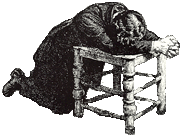
You saw only yesterday a strong man in your neighborhood brought to the grave by sudden death; it is only a month ago that you heard the bell toll for one whom once you knew and loved, who procrastinated and procrastinated until he perished in procrastination. You have had strange things happen in your very street, and the voice of God has been spoken loudly through the lip of Death to you. Yes, and you have had warnings too in your own body, you have been sick with fever, you have been brought to the jaws of the grave, and have looked down into the bottomless vault of destruction.
It is not long ago since you were given up—all said they might prepare a coffin for you, for your breath could not long be in your body. Then you turned your face to the wall and prayed; you vowed that if God would spare you, you would live a godly life, that you would repent of your sins; but to your own confusion you are just what you were.
Ah! let me tell you, your guilt is more grievous than that of any other man, for you have sinned presumptuously, in the very highest sense in which you could have done so. You have sinned against reproofs, but what is worse still, you have sinned against your own solemn oaths and covenants, and against the promises that you made to God.
He who plays with fire must be condemned as careless; but he who has been burned out once, and afterwards plays with the destroying element, is worse than careless; and he who has himself been scorched in the flame, and has had his locks all hot and crisp with the burning, if he again should rush headlong into fire, I say he is worse than careless, he is worse than presumptuous, he is mad. But I have some such here.
They have had warnings so terrible that they might have known better; they have gone into lusts which have brought their bodies into sickness, and perhaps this day they have crept up to this house, and they dare not tell to their neighbor who stands by their side what is the loathsomeness that even now breeds upon their body.
And yet they will go back to the same lusts; the fool will go again to the stocks, the sheep will lick the knife that is to slay him.
You will go in your lust and in your sins, despite warnings, despite advice, until you perish in your guilt. How worse than children are grownup men!
The child who goes for a merry slide upon a pond, if he be told that the ice will not bear him, turns back in fear, or if he daringly creeps upon it, how soon he leaves it, if he hears but a crack upon the slender covering of the water!
But you men have conscience, which tells you that your sins are vile, and that they will be your ruin, you hear the crack of sin, as its thin sheet of pleasure gives way beneath your feet; yes, and some of you have seen your comrades sink in the flood, and lost; and yet you go sliding on, worse than childish, worse than mad are you, thus presumptuously to play with your own everlasting state.
O my God, how terrible is the presumption of some!
How fearful is presumption of any!
Oh ! that we might be enabled to cry, "Keep back your servant also from presumptuous sins."
By Charles H. Spurgeon
Tuesday, January 02, 2007
CHRIST OUR LIGHT
John 8:12 "Then spake Jesus again unto them, saying, I am the light of the world: he that followeth me shall not walk in darkness, but shall have the light of life."
IT was the Feast of Tabernacles when our Lord uttered the words of our text, and it is supposed they were lighting the two great candelabra, which commemorated the fire-cloud that led the desert march. It was in direct allusion to the fiery pillar that our Lord used this metaphor. What that was to Israel, He is to His Church.
The wilderness was a trackless waste to Israel. The people absolutely depended on the cloud to show their path, and to find a resting-place at night. When it gathered itself up from the Tabernacle on which it brooded, the people must strike their tents and follow. However desirable the site of their camp, they must leave it; however difficult the desert paths, they must traverse them; however uninviting the spot where it stopped, they must halt there, and remain as long as it tarried. To linger was to run the risk of wandering aimlessly in the desert till death supervened. Only where the cloud rested did the manna fall, the water flow, or divine protection avail.
There are resting-times in our lives. God graciously arranges green pastures and quiet waters, and makes us to lie down. His voice sounds amid the turmoil of our existence, and bids us come aside and rest awhile. But often we fret against enforced rest, we persist in hurrying to and fro, and give way to bitter repining. When the cloud stays, remain where you are. When you do not know what to do, stop until some indication points your path.
There are times for action. The trumpet is heard with its summons, to which we must give immediate attention. When the sleeper refuses to arise instantly at the sound of the alarum, he soon becomes so accustomed to it that it does not disturb him. So we shall gain a keen sense of hearing when we accustom ourselves to instant obedience. The peace and usefulness of our earthly life will be in direct proportion to our appropriation of the Lord Jesus for all the demands of our pilgrim condition. Nay, more, for as in the train, the electric light comes on before the dark tunnel is entered, and lingers after it is passed, so the presence of Christ will precede and follow times of special need. “I will make darkness light before them, and crooked things straight” (Isa 42:16).
PRAYER-O send out Thy light and Thy truth, and let them lead me and bring me at last to my Father's house in peace. AMEN
By F.B. Meyer
IT was the Feast of Tabernacles when our Lord uttered the words of our text, and it is supposed they were lighting the two great candelabra, which commemorated the fire-cloud that led the desert march. It was in direct allusion to the fiery pillar that our Lord used this metaphor. What that was to Israel, He is to His Church.
The wilderness was a trackless waste to Israel. The people absolutely depended on the cloud to show their path, and to find a resting-place at night. When it gathered itself up from the Tabernacle on which it brooded, the people must strike their tents and follow. However desirable the site of their camp, they must leave it; however difficult the desert paths, they must traverse them; however uninviting the spot where it stopped, they must halt there, and remain as long as it tarried. To linger was to run the risk of wandering aimlessly in the desert till death supervened. Only where the cloud rested did the manna fall, the water flow, or divine protection avail.
There are resting-times in our lives. God graciously arranges green pastures and quiet waters, and makes us to lie down. His voice sounds amid the turmoil of our existence, and bids us come aside and rest awhile. But often we fret against enforced rest, we persist in hurrying to and fro, and give way to bitter repining. When the cloud stays, remain where you are. When you do not know what to do, stop until some indication points your path.
There are times for action. The trumpet is heard with its summons, to which we must give immediate attention. When the sleeper refuses to arise instantly at the sound of the alarum, he soon becomes so accustomed to it that it does not disturb him. So we shall gain a keen sense of hearing when we accustom ourselves to instant obedience. The peace and usefulness of our earthly life will be in direct proportion to our appropriation of the Lord Jesus for all the demands of our pilgrim condition. Nay, more, for as in the train, the electric light comes on before the dark tunnel is entered, and lingers after it is passed, so the presence of Christ will precede and follow times of special need. “I will make darkness light before them, and crooked things straight” (Isa 42:16).
PRAYER-O send out Thy light and Thy truth, and let them lead me and bring me at last to my Father's house in peace. AMEN
By F.B. Meyer
Sunday, December 17, 2006
It's a Wonderful Life ....a classic film
 This story, which I got to watch for probably the 100th time, was once again on TV tonight.
Most people know the story starring Jimmy Stewart, as George Bailey, who after having his world cave in on him, contemplates suicide but ends up meeting an Angel, by the name of Clarence, who allows George to see what his world would be like if he had never been born...of how lives he has touched, would be so very different.
Usually as I watch this film I always find myself pondering on my own life and wondering if I had made a difference in anyone's life for the better: I think that comes with age.
My thoughts were taken this time though to the Life of Jesus, pondering on his birth we celebrate at this Christmas season, his life as a baby, and his controversial years in ministry, when he was hated by so many he walked among, ....
And instead of wondering what it would be like if I hadn't been born, like our friend George Bailey, I wondered what it would be like if Jesus had never taken on flesh and come down from on high to be born as a helpless baby 2000 years ago, all to save mankind, to take our place on that cross, and bleed and die for us, offering the one and only perfect sacrifice, himself, for sinful men, and women;...that's you and me, by the way.
I can't imagine, and don't want to think about what my life would be like today without Jesus.
I also pondered tonight while watching that film, what Mary's life was like...what she thought during those months while carrying the Son of God. And what she must have pondered on during the next 33 years, watching him stumble and fall as a young child, grow into a teen, work along side Joseph in the carpentry shop, enter into His ministry, be loved by a few and hated by others...and ultimately die on that cross.
Wonder if she questioned things in her heart or knew why?
Just sharing my thoughts ...
Mary, did you know
That your baby boy
Would someday walk on water?
Mary did you know
That your baby boy
Will save our sons and daughters?
Did you know
That your baby boy
Has come to make you new?
This child that you've delivered
Will soon deliver you.
Mary did you know
That your baby boy
Will give sight to a blind man?
Mary did you know
That your baby boy
Will calm the storm with his hand?
Did you know that your baby boy
Has walked where angels trod?
When you kiss your little baby
You've kissed the face of God.
The blind will see
The deaf will hear
The dead will live again
The lame will leap
The dumb will speak
The praises of the Lamb
Mary did you know
That your baby boy
Is Lord of all creation?
Mary did you know
That your baby boy
Will one day rule the nations?
Did you know
That your baby boy
Is heaven's perfect Lamb?
This sleeping child you're holding
Is the Great I Am
That your baby boy
Would someday walk on water?
Mary did you know
That your baby boy
Will save our sons and daughters?
Did you know
That your baby boy
Has come to make you new?
This child that you've delivered
Will soon deliver you.
Mary did you know
That your baby boy
Will give sight to a blind man?
Mary did you know
That your baby boy
Will calm the storm with his hand?
Did you know that your baby boy
Has walked where angels trod?
When you kiss your little baby
You've kissed the face of God.
The blind will see
The deaf will hear
The dead will live again
The lame will leap
The dumb will speak
The praises of the Lamb
Mary did you know
That your baby boy
Is Lord of all creation?
Mary did you know
That your baby boy
Will one day rule the nations?
Did you know
That your baby boy
Is heaven's perfect Lamb?
This sleeping child you're holding
Is the Great I Am
*to listen- http://www.wrensworld.com/marydiduknow.htm
Sunday, December 03, 2006
Are you still searching?

Life is like a journey, it is my opinion that from young to old, we are ever in the process of searching. Searching for what you may ask? For most people, we are searching for satisfaction and happiness.
Many spend their energy and time on gaining material wealth, thinking that financial security is the answer to satisfaction in life. Others seek satisfaction in friendship, in relationships. And a great number seek satisfaction in pleasure, in the form of food and drinks and sex, and even drugs.
It is my observation that such satisfaction will not last. When we die, all our material wealth will depart from us, even a good relationship will not last, because people may change, and even our loved ones will depart from us when we or they die.
And the pleasure we seek are temporary and may lead us to addiction, bondage, pain and sickness.
Some seek satisfaction in fame and achievement, in intellectual pursuit. But even this will not last forever, when we die one day, all our achievement and glory means nothing, it will fade away.
So I like to suggest that we seek satisfaction in the right thing, things that will last forever. These are the spiritual things.
There is one person in history that promises this satisfaction, He is Jesus Christ and He says He has come to give us an abundant life:
John 10:10 The thief cometh not, but for to steal, and to kill, and to destroy: I am come that they might have life, and that they might have it more abundantly.
The irony is, to get this abundant life, you must surrender your life to Jesus. For Jesus also says:
Matthew 10:39 He that findeth his life shall lose it: and he that loseth his life for my sake shall find it.
It takes faith to do that, but Jesus will keep his promise to you. What do we mean to lose our life in order to find life? We have to give the control of our life to Jesus, making Jesus the Lord over us. We have to give up things in our life that displeases God. This invitation to an abundant life is open to all, are you tired of seeking so many things in life only to find that it is emptiness? Do you labour with no peace and you have a heavy burden? Jesus says to you:
Matthew 11:28-29 Come unto me, all ye that labour and are heavy laden, and I will give you rest. Take my yoke upon you, and learn of me; for I am meek and lowly in heart: and ye shall find rest unto your souls.
You can find rest and satisfaction in Jesus. Click on the link “Do you know for sure?” on the left to find out more how you can begin this abundant life, don’t wait any longer.
Subscribe to:
Posts (Atom)